HomeAll booksFive Children and It
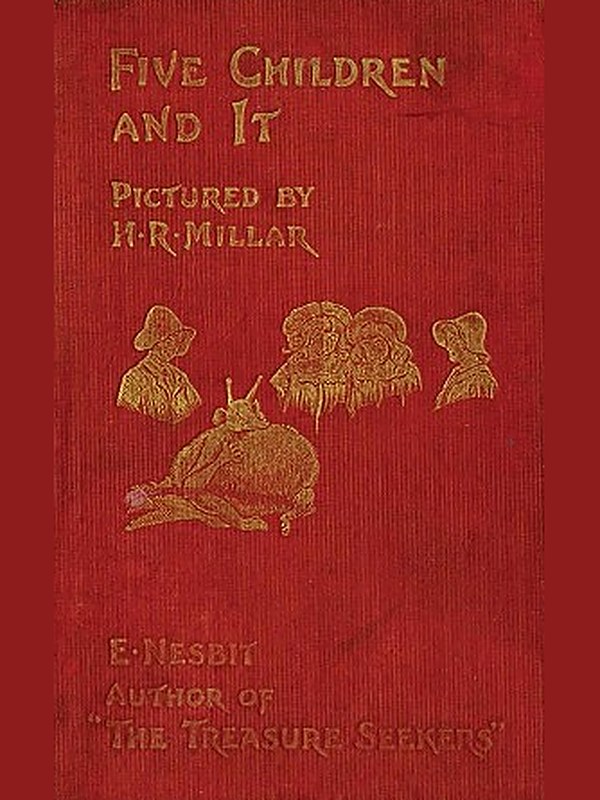
Five Children and It cover
Fantasy · Funny

Five Children and It

E. Nesbit · first published 1902

Four children and a baby dig up a bad-tempered sand-fairy that grants one wish a day — and every wish has gone wrong by teatime.

Free EPUB & KindleGrades 4–7Original H. R. Millar art
Worth knowing ⓘ
Worth knowing: Chapter ten. Cyril has been reading The Last of the Mohicans and wishes for 'Red Indians in England — not big ones, you know, but little ones, just about the right size for us to fight'; the wish is granted. 'Red Indian' appears twelve times in the chapter and 'squaw' once, along with war paint, tomahawks and scalping-knives. The garbled speech in the chapter is Anthea's, not the Indians': bluffing, she tells them to 'smoke pipes of peace in your wampums with your squaws... and eat happily of the juicy fresh-caught moccasins,' and her brother tells her she has it all wrong. The chief, Golden Eagle, speaks what Nesbit calls 'excellent English.' The children are tied up and a fire is laid to burn them; the chapter ends when the chief wishes himself back to his own forests and vanishes. No one is scalped. In chapter three the children meet a gipsy encampment; a wish has made everyone want the baby, and the gipsy women — described by the colour of their skin — try to keep him. Elsewhere: the children are stranded on a church tower after dark when their wings vanish at sunset and the vicar takes them for burglars; Robert, wished giant-sized, has a fistfight with the baker's boy; a besieged castle leaves them hungry for an evening; and Anthea breaks open a missionary-box with a poker.

EPUB works on any device · two-minute setup guide → ·listening, print & film links go to Amazon (affiliate)

Why your kid will love it

01

The wish always backfires

They wish to be beautiful and the servants won't let them in the house. They wish for gold and can't spend a coin of it. Nothing the Psammead does is a trick — the children just never finish the sentence, and after two chapters a kid starts spotting the hole before the children fall in it.

02

It resets at sunset

Every catastrophe expires when the sun goes down, and the children walk back to the gravel-pit the next morning to do it again. That rule is what lets a kid enjoy total disaster without a knot in their stomach — nothing can actually stay broken.

03

The sand-fairy is rude

It has a spider's body, bat's ears and eyes on stalks, it grants wishes only under protest, and it blows itself up like a balloon to do it, complaining the whole time. This is not a fairy godmother, and kids who are tired of being encouraged find it very refreshing.

Reading it together?

Warm-ups, real questions, and something to do together. No worksheets.Book club questions →

The background for parents

The pitch

Four children and a baby take a house in the country for the summer, dig in the gravel-pit for something to do, and turn up something ancient and irritable: a sand-fairy, all fur and snail’s eyes, that grants one wish a day and accepts no responsibility whatever for the results. The wishes are reasonable enough — to be beautiful, to be rich, to have wings — and each one is a catastrophe by teatime. Then the sun goes down, everything is undone, and they walk back to the pit the next morning to try again.

What to know

Eleven chapters, each one a complete wish and its collapse, which makes this a natural chapter-a-night book and an unusually good one to read aloud — the comedy is broad enough that a six-year-old listener laughs in the same places a ten-year-old reader does. The English is Edwardian and a little formal, and the slang has to be taken on trust (“it’s a pretty decent average ghastly mess this time”), so a grade-4 reader wants a running start and a grade-6 reader flies. Our edition is the complete 1905 Dodd, Mead first American text, carrying all forty-seven of H. R. Millar’s original drawings — the ones Nesbit’s first readers saw, several still signed and dated in the plate — along with her verse dedication to her youngest child. Chapter ten, in which Cyril wishes for Red Indians and gets them, is dated straight through; the content note has the specifics, and flags the rest.

Life when written

Nesbit wrote this at Well Hall, an eighteenth-century house at Eltham in Kent that the family had moved into in 1899 and where she went on to write nearly all her children’s books. It ran first as a serial through 1902 in the Strand Magazine — the monthly that had made Sherlock Holmes a household name — under the title “The Psammead,” which is why this edition still carries her note saying so. The setting is the ground outside her own door: chalk quarries and gravel-pits were ordinary working landscape in that part of Kent, the sort of thing a family took a summer house near without thinking about it, and a child could dig in one all day and nobody minded. She dedicated the book to John, the youngest in her house, who was three, and who — as the poem admits — had not learned to read a word of it.
The book vs. the movie

The 2004 film moves the whole story into the First World War and hands the children a missing father to find. The 1991 BBC serial is the one that just films the book.How they differ →

If they like it, read these next

Modern books (still in copyright, so not free) that scratch the same itch.

Half Magic by Edward Eager

Four siblings find a charm that grants exactly half of every wish, so they have to learn to ask for twice what they want. Eager wrote openly in Nesbit's debt and even has his characters read her — this is the closest thing in print to another Psammead summer.

Four Children and It by Jacqueline Wilson

For the kid who finishes this one and wants more: modern children in a modern blended family dig up the same Psammead in the same gravel-pit. Wilson wrote it as a direct descendant, and it answers the question kids always ask, which is what It did next.

Affiliate links. They never affect our picks.

Prefer a printed copy? Puffin Classics paperback (affiliate links). Not sure whether your reader needs the original or an abridged edition? Our guide to choosing →

Read it on any device

Quick answers

What age is Five Children and It right for?

We shelve it for grades 4–7 — that's where the language and the length sit for a reader on their own. Read aloud, it works earlier, from about age 6–7 — kids follow a story by ear well before they can read it alone.

What reading level is Five Children and It?

The unabridged text measures 980L Lexile, AR level 5.7. In everyday terms: grades 4–7, and easier as a read-aloud.

Is Five Children and It scary?

Mild — a night stranded on a church tower. Chapter ten. Cyril has been reading The Last of the Mohicans and wishes for 'Red Indians in England — not big ones, you know, but little ones, just about the right size for us to fight'; the wish is granted. 'Red Indian' appears twelve times in the chapter and 'squaw' once, along with war paint, tomahawks and scalping-knives. The garbled speech in the chapter is Anthea's, not the Indians': bluffing, she tells them to 'smoke pipes of peace in your wampums with your squaws... and eat happily of the juicy fresh-caught moccasins,' and her brother tells her she has it all wrong. The chief, Golden Eagle, speaks what Nesbit calls 'excellent English.' The children are tied up and a fire is laid to burn them; the chapter ends when the chief wishes himself back to his own forests and vanishes. No one is scalped. In chapter three the children meet a gipsy encampment; a wish has made everyone want the baby, and the gipsy women — described by the colour of their skin — try to keep him. Elsewhere: the children are stranded on a church tower after dark when their wings vanish at sunset and the vicar takes them for burglars; Robert, wished giant-sized, has a fistfight with the baker's boy; a besieged castle leaves them hungry for an evening; and Anthea breaks open a missionary-box with a poker.

Is the free ebook really the whole book?

Yes — the complete, unabridged text, with the original H. R. Millar illustrations. Five Children and It was published in 1902, so it's in the US public domain: sharing it free is legal, and there's no signup or catch. We build the ebook ourselves from the original edition.

More free classics like this