HomeAll booksGulliver's Travels
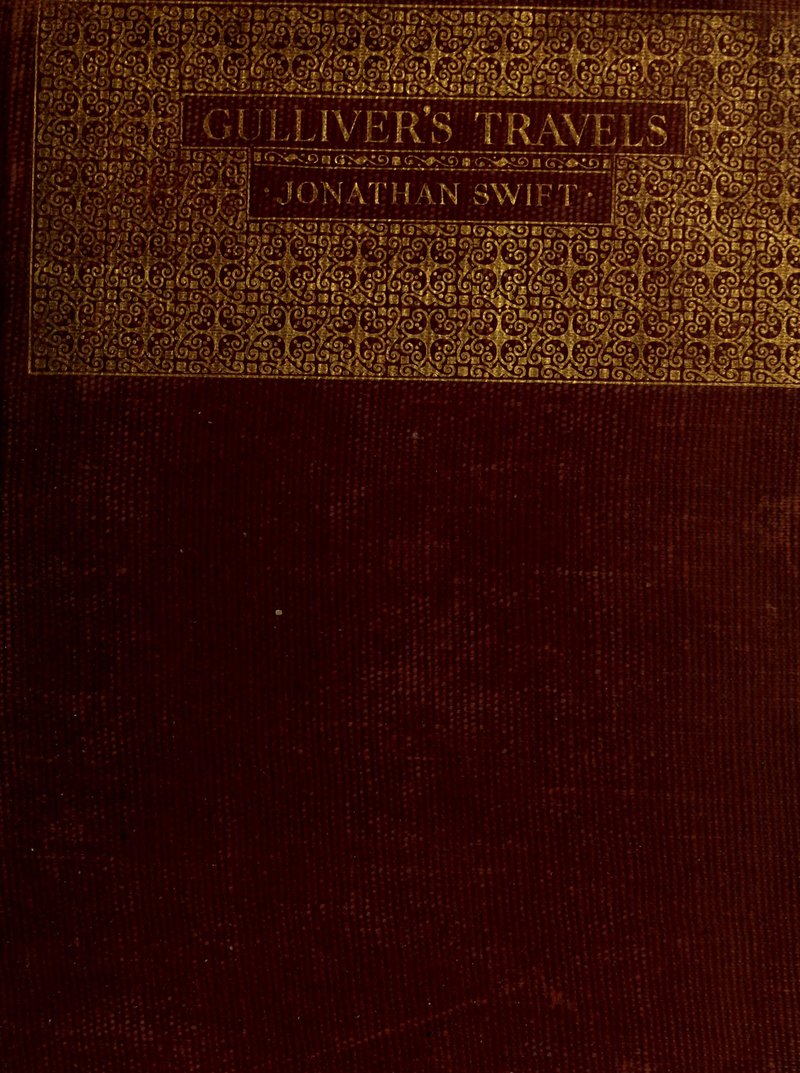
Gulliver's Travels cover
Adventure · Fantasy

Gulliver's Travels

Jonathan Swift · first published 1726

A ship's surgeon is wrecked four times over — among people six inches high, among giants who keep him in a box, on an island that floats above its own kingdom, and finally in a country where the horses are reasonable and the humans are animals — and comes home unable to bear the smell of his own wife.

Free EPUB & KindleGrades 8–12
Worth knowing ⓘ
Worth knowing: This is a satire written for adults, and the four parts get progressively less suitable for a younger reader. Part I: Gulliver describes relieving himself in some detail in chapter two, and in chapter five he puts out a fire in the Empress's apartment by urinating on it — 'the wine begin to operate by urine; which I voided in such a quantity, and applied so well to the proper places, that in three minutes the fire was wholly extinguished.' Chapter seven then prints the formal charge against him for having done it 'maliciously, traitorously, and devilishly.' The punishment the court settles on instead of death is blinding. Part II: in chapter four a beggar-woman's cancerous breast is described at close range, 'full of holes,' along with lice 'rooting like swine'; chapter five has the maids of honour stripping him naked and laying him in their bosoms for entertainment, and a public execution where the head comes off with a sword forty feet long and the blood goes higher than the fountains at Versailles. Part III: the projectors of Lagado work with excrement in two chapters, one of them proposing to detect treason by examining it; chapter ten introduces the Struldbrugs, immortals who never die and never stop decaying — 'at ninety, they lose their teeth and hair,' then their memory, then their language — which is the bleakest thing in the book. Part IV is the hardest: the Yahoos are human beings drawn as filthy animals, and Swift describes their bodies, their excrement-throwing and their sexual behaviour plainly; in chapter eight a young female Yahoo, 'inflamed by desire,' leaps into the river at Gulliver while he is bathing. The ending is not a happy one. Gulliver comes home and cannot stand his family: he faints when his wife kisses him, buys two horses to talk to four hours a day, and by the last page has begun 'to permit my wife to sit at dinner with me, at the farthest end of a long table' while keeping his nose stopped with rue and lavender against the smell of her. There is no racial slur anywhere in the book, and no word here is one we have altered. The prose is 1726 — long sentences, semicolons, capitalised nouns, and a narrator who reckons distances in English miles and money in sprugs.

EPUB works on any device · two-minute setup guide → ·listening, print & film links go to Amazon (affiliate)

Why your kid will love it

01

They search his pockets and write it up

The Lilliputians send two officers to inventory everything on him, and the report is printed in full: a comb built like a palisado, a net large enough for a fisherman that opens and shuts like a purse, and 'a wonderful kind of engine' that makes a noise like a water-mill, which the Man-Mountain 'called his oracle, and said, it pointed out the time for every action of his life.' It is a pocket watch described by people who have never seen one. Kids who like a puzzle told backwards will read that page twice.

02

Scale, done properly and then reversed

In Lilliput he is a mountain: they build a platform to feed him, and the whole navy of a rival empire fits in his hand. Two hundred pages later he is six inches tall in Brobdingnag and everything has teeth — wasps the size of partridges, a rat he has to fight with his sword, a monkey that carries him up a roof and tries to feed him, a hailstorm that nearly kills him. Swift does the arithmetic every single time, and it is the arithmetic that makes it real.

03

The Academy of Lagado

Gulliver tours a research institute where one man has spent eight years extracting sunbeams from cucumbers to bottle for cold summers, another is building houses from the roof down, and a professor has a wooden frame of forty handles that shuffles every word in the language so that his students can copy out whatever accidentally makes sense. We ship the picture of that frame — it is printed in the book — and it is the funniest, most modern-feeling forty pages Swift wrote.

Reading it together?

Warm-ups, real questions, and something to do together. No worksheets.Book club questions →

The background for parents

The pitch

Lemuel Gulliver is a competent, unimaginative ship’s surgeon with a wife in Redriff and a habit of going back to sea, and over sixteen years he is shipwrecked, marooned, abandoned and set adrift into four countries that should not exist. In Lilliput he is a mountain tethered by ropes, dragged into a war over which end of an egg to break. In Brobdingnag he is six inches tall, kept in a box, and everything from a wasp to a monkey is trying to kill him. On the flying island of Laputa the noblemen are too busy thinking to hear anyone speak, and in the academy below a man is eight years into bottling sunlight from cucumbers. Then he lands among horses who reason, keeping a race of filthy human animals for labour, and works out — slowly, and then all at once — which species he belongs to. He comes home and cannot bear his family. It is 300 years old, it is very funny for about two thirds of its length, and the last part is one of the angriest things anybody has ever written.

What to know

Two things surprise people about this book. The first is that it is not a children’s story and never was: Swift was a Dublin dean writing a political attack on the England of 1726, and the Lilliput everybody knows is one quarter of it. The second is how hard the sentences are. Published measures put it at 1300L and ATOS 13.5, higher than our Robinson Crusoe, and the AR quiz for the unabridged text is worth 25 points. Shopping for it is where families get caught — nearly every “Gulliver’s Travels” on a shelf is Lilliput on its own, or an adaptation: the Stepping Stones version sits at 590L, and the D.C. Heath school edition, which is the one Gutenberg carries with pictures, prints Parts I and II and stops. Ours is the complete text — all four voyages, thirty-nine chapters, the two pieces of front matter, and the Lindalino episode that was suppressed in the first printings and not restored until 1735. It is plain: the one illustrated edition of the whole book on Gutenberg quietly cuts about 4,700 words of Swift, every one of them a passage somebody found coarse, so we took the complete text and the cover instead. There is exactly one picture in here, and it is the book’s own — the diagram of the word-machine at Lagado, printed in the first edition, which the prose sends you to look at. Swift’s chapter arguments are set apart under each chapter number the way the printed page sets them, so you can see where you are going. Read the content note before handing this over; the difference between Part I and Part IV is enormous and it is the whole design.

Life when written

Swift was about fifty-eight and living in Dublin as Dean of St Patrick’s, a post he considered a punishment. He had wanted a bishopric in England, had been a political insider under the Tory ministry until Queen Anne died in 1714, and had watched the Whigs come in and his career end. What he did with the exile was write. In 1724 he published the Drapier’s Letters anonymously, arguing that a patent granted to an English ironmonger named William Wood to mint copper halfpence for Ireland was a swindle; the campaign worked, the patent was withdrawn, and a reward of £300 for naming the author went unclaimed, because the printer would not talk and neither would Dublin. He was writing Gulliver’s Travels during exactly those years, and the rebellion of Lindalino in Part III — a city that fights off a flying island by putting loadstones on its towers — is that fight, with the serial numbers filed off. He sent the manuscript to London in 1726 by way of a friend who dropped it at the publisher’s door at night, and the printer softened the sharpest passages before setting it, which is what Gulliver’s furious letter to Cousin Sympson at the front of this edition is complaining about. It sold out in a week. Swift’s own line, in a letter to Alexander Pope, was that he wrote it “to vex the world rather than divert it.”
The book vs. the movie

The 1996 miniseries is the only adaptation that has ever gone past Brobdingnag, and it keeps the fire in Lilliput and the Yahoos both — but it invents an asylum, a scheming doctor and a rescue by Gulliver's wife, none of which is in Swift.How they differ →

If they like it, read these next

Modern books (still in copyright, so not free) that scratch the same itch.

The Phantom Tollbooth by Norton Juster

For the reader who liked the invented countries more than the shipwrecks. Milo drives through a tollbooth into kingdoms where an idea is taken absolutely literally and then walked to its silly conclusion — Dictionopolis sells words by the bushel, Digitopolis mines numbers — which is exactly the engine Laputa and Lagado run on, at a length and an age a fifth grader can take.

For the teenager who got the joke. An ordinary Englishman is dragged through a series of civilisations that are all recognisably ours with one thing exaggerated, reports it deadpan, and ends up thinking less of the species than he started. It is the same book with the sea replaced by space, and it is the version a fourteen-year-old will finish in a weekend.

Affiliate links. They never affect our picks.

Prefer a printed copy? Penguin Classics paperback — unabridged, with Robert DeMaria Jr.'s notes on the 1726 politics, the Irish coinage row and the science Swift is mocking (affiliate links). Not sure whether your reader needs the original or an abridged edition? Our guide to choosing →

Read it on any device

Quick answers

What age is Gulliver's Travels right for?

We shelve it for grades 8–12 — that's where the language and the length sit for a reader on their own. Read aloud, it works earlier, from about age 12–13 — kids follow a story by ear well before they can read it alone.

What reading level is Gulliver's Travels?

The unabridged text measures 1300L Lexile, AR level 13.5 (25 points). (unabridged settings are listed 1300L–1370L; the 590L figure belongs to the Stepping Stones adaptation and the picture-book Gulliver in Lilliput is lower still.) In everyday terms: grades 8–12, and easier as a read-aloud.

Is Gulliver's Travels scary?

Not frightening so much as disturbing — see the note. This is a satire written for adults, and the four parts get progressively less suitable for a younger reader. Part I: Gulliver describes relieving himself in some detail in chapter two, and in chapter five he puts out a fire in the Empress's apartment by urinating on it — 'the wine begin to operate by urine; which I voided in such a quantity, and applied so well to the proper places, that in three minutes the fire was wholly extinguished.' Chapter seven then prints the formal charge against him for having done it 'maliciously, traitorously, and devilishly.' The punishment the court settles on instead of death is blinding. Part II: in chapter four a beggar-woman's cancerous breast is described at close range, 'full of holes,' along with lice 'rooting like swine'; chapter five has the maids of honour stripping him naked and laying him in their bosoms for entertainment, and a public execution where the head comes off with a sword forty feet long and the blood goes higher than the fountains at Versailles. Part III: the projectors of Lagado work with excrement in two chapters, one of them proposing to detect treason by examining it; chapter ten introduces the Struldbrugs, immortals who never die and never stop decaying — 'at ninety, they lose their teeth and hair,' then their memory, then their language — which is the bleakest thing in the book. Part IV is the hardest: the Yahoos are human beings drawn as filthy animals, and Swift describes their bodies, their excrement-throwing and their sexual behaviour plainly; in chapter eight a young female Yahoo, 'inflamed by desire,' leaps into the river at Gulliver while he is bathing. The ending is not a happy one. Gulliver comes home and cannot stand his family: he faints when his wife kisses him, buys two horses to talk to four hours a day, and by the last page has begun 'to permit my wife to sit at dinner with me, at the farthest end of a long table' while keeping his nose stopped with rue and lavender against the smell of her. There is no racial slur anywhere in the book, and no word here is one we have altered. The prose is 1726 — long sentences, semicolons, capitalised nouns, and a narrator who reckons distances in English miles and money in sprugs.

Is the free ebook really the whole book?

Yes — the complete, unabridged text. Gulliver's Travels was published in 1726, so it's in the US public domain: sharing it free is legal, and there's no signup or catch. We build the ebook ourselves from the original edition.

More free classics like this