HomeAll booksRobinson Crusoe
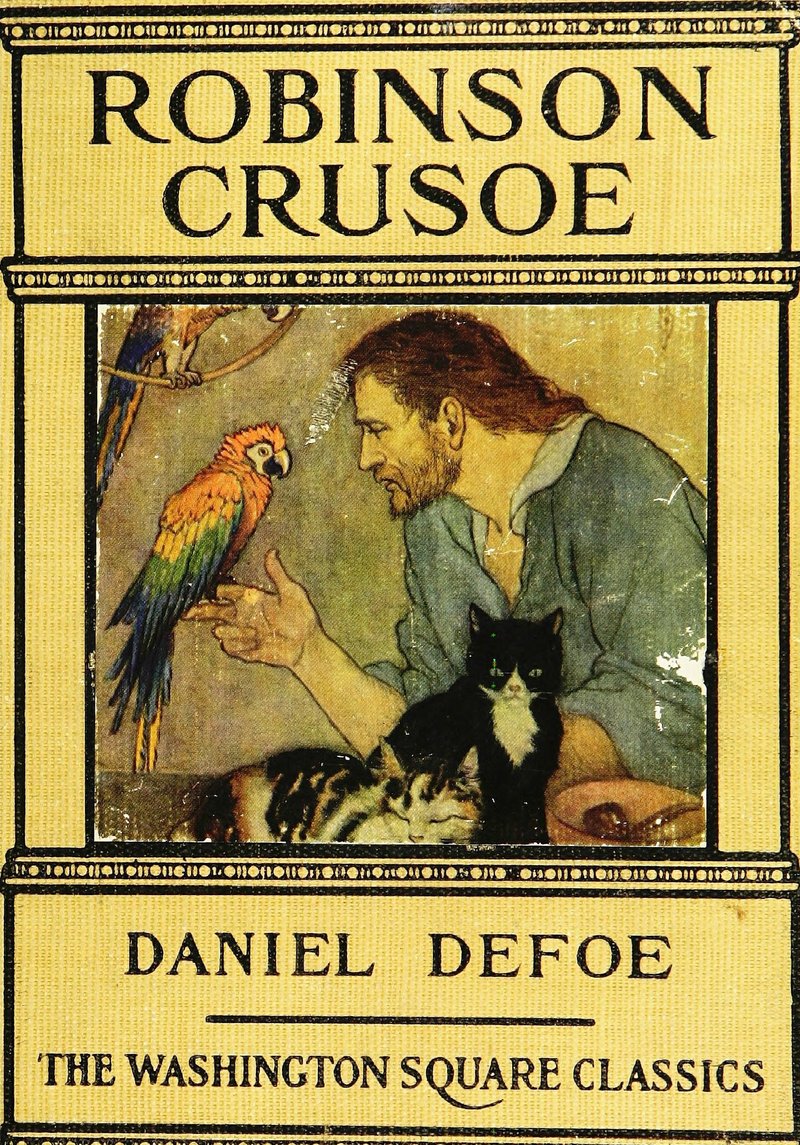
Robinson Crusoe cover
Adventure

Robinson Crusoe

Daniel Defoe · first published 1719

A young man ignores his father, runs off to sea, and is thrown alone onto an island where he stays for twenty-eight years — and most of the book is him working out, object by object, how to stay alive and stay sane.

Free EPUB & KindleGrades 8–12
Worth knowing ⓘ
Worth knowing: Crusoe deals in enslaved people, and the book does not treat it as a scandal. In chapter three he sells Xury — the boy who escaped Barbary captivity with him and rowed beside him for weeks — to a Portuguese captain for sixty pieces of eight, saying he 'was very loth to sell the poor boy's liberty, who had assisted me so faithfully in procuring my own,' and then does it anyway. Once in Brazil he 'bought me a negro slave.' The voyage that wrecks him is a trip to Guinea to buy enslaved Africans for the planters, and the shipwreck is the direct result. Chapter fourteen: he names the man he rescues after the day of the week, and 'I likewise taught him to say Master; and then let him know that was to be my name.' The word 'savages' appears 104 times; 'negroes' is used throughout the African chapters. On cannibalism, Defoe is graphic — chapter twelve has Crusoe finding the shore 'spread with skulls, hands, feet, and other bones of human bodies' around a fire pit — and he spends two chapters debating whether he is entitled to kill people for it before he does, repeatedly. Deaths: the crew of two ships drowned, a lion and a leopard shot in Africa, many cannibals shot and blown up, mutineers hanged or killed, and in the last chapter a wolf pack attacks the party in the Pyrenees and Friday baits a bear for sport. Religion is not a background detail: Crusoe's conversion is the spine of the middle third, he reads Scripture daily, 'God' appears 158 times and 'Providence' 35, and he converts Friday. The prose is 1719 — long sentences, semicolons, spelling and money that will need explaining.

EPUB works on any device · two-minute setup guide → ·listening, print & film links go to Amazon (affiliate)

Why your kid will love it

01

He salvages the wreck twelve times

Before the ship breaks up, Crusoe builds a raft and goes back and back and back: biscuit, rum, gunpowder, three Bibles, a grindstone, two saws, a hatchet, nails, and — on the last trip — razors, scissors and knives. He counts it all. Kids who take apart the shed, pack for camp a week early, or have opinions about what belongs in a go-bag will read this like a manual.

02

The footprint

Fifteen years in, alone the whole time, he finds one bare human footprint in the sand. He goes home 'like a man pursued,' does not sleep, and spends the next several chapters frightened out of his wits by the possibility of company. It is one of the great shocks in English fiction and it is a single foot.

03

Everything is made wrong first

His first canoe is beautiful and too heavy to move, so it rots where he built it. His first pots slump in the fire. His first bread takes months because he has to invent the sieve. Defoe lets him fail and start over in full detail, which is exactly the part most retellings cut and exactly the part that makes a kid believe the island is real.

Reading it together?

Warm-ups, real questions, and something to do together. No worksheets.Book club questions →

The background for parents

The pitch

Robinson Crusoe goes to sea against his father’s explicit advice, survives a storm that should have cured him, is captured by pirates and enslaved at Sallee, escapes, prospers as a planter in Brazil, and then — because he is a man who cannot leave well enough alone — sails for Guinea to buy enslaved Africans and is wrecked alone on an island near the mouth of the Orinoco. He is twenty-seven. He is there until he is fifty-five. What fills those years is not adventure but work: a raft, a fence, a cave, a calendar cut into a post, goats, barley, a canoe too heavy to launch, and a pot that finally holds water. Then, fifteen years in, he finds a footprint. The book is old, strange, and much more gripping than its reputation, and it is the ancestor of every survival story your kid has ever read.

What to know

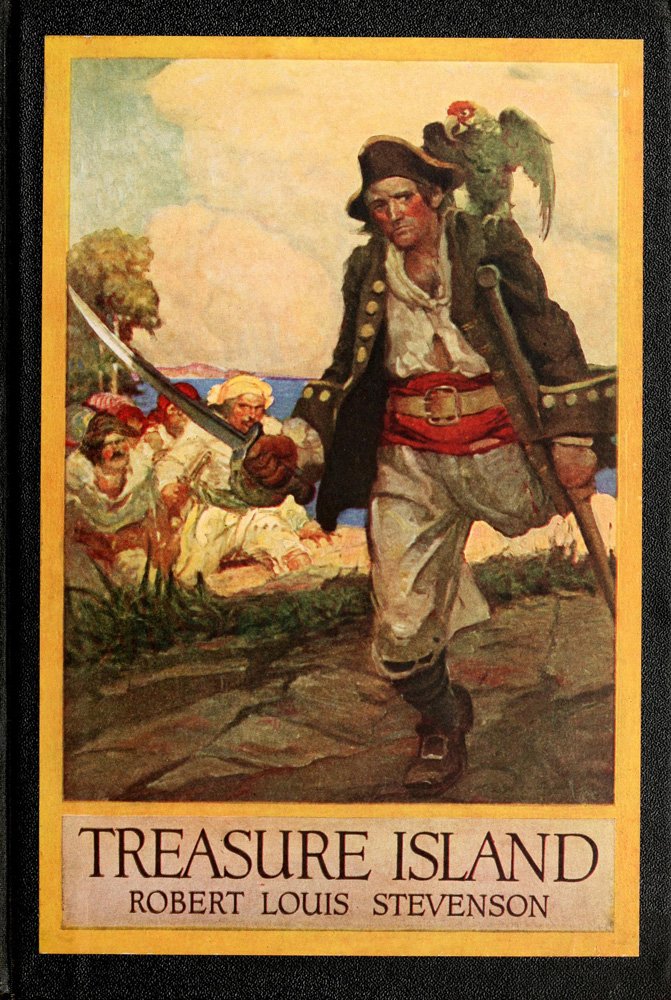
The difficulty here is not the story, it is the sentences. This is 1719 English — long, looping, semicoloned, with money in pieces of eight and a narrator who will interrupt an escape to reckon up what it cost him. Published measures put it at 1270L and ATOS 12.3, which is high-school text; the AR quiz for the full text is worth 27 points against 121,961 words. Be careful shopping for it, because most “Robinson Crusoe” on the market is not this book: the retellings sit at ATOS 3.2 to 5.9, and even the beautiful 1920 N. C. Wyeth edition is abridged — it stops when Crusoe leaves the island and loses the last 10,600 words, the Pyrenees wolves and the bear along with them. Ours is complete, in twenty chapters with their own titles. Defoe wrote no chapters at all; every division you will ever see in a printed Crusoe is an editor’s, and we use the one edition on Gutenberg that has them, because 121,000 unbroken words is not a thing to hand a thirteen-year-old. There are no illustrations — the plates for this text were never scanned — so what you get is the cover, which is the 1920 Philadelphia board, and clean text. Chapter four prints Crusoe’s debtor-and-creditor ledger as the two columns Defoe set it in, which is worth seeing laid out properly. One warning for the last page: the book ends by promising “the Second Part of my Story,” and there really is one — The Farther Adventures of Robinson Crusoe, published the same year, in which he goes back to the island and then across Siberia. Nobody reads it, and it is not a children’s book; a kid who finishes this one and asks for the sequel is better sent to the comparables below. The content note is long and you should read it: the slave trade is in this book as ordinary business.

Life when written

Defoe was about fifty-nine, and this was his first novel. He had spent his life as a merchant — hosiery, woollen goods, wine — gone bankrupt in 1692 owing something like £17,000, been arrested for it, and then in July 1703 stood in the pillory for three days for a pamphlet, The Shortest-Way with the Dissenters, whose satire on religious persecution was so deadpan that both sides took it literally. He got out by agreeing to work as a government intelligence agent, which he did for years, including undercover in Scotland during the negotiations for the Union. Somewhere between 500 and 550 titles have been attributed to him and almost none of them were fiction until he was nearly sixty, when Robinson Crusoe came out on 25 April 1719 from William Taylor’s shop and went through four editions before Christmas. Readers took it for a true account, which was the point — a man who had made a living writing convincing things that were not quite true had finally found the form for it. Some of it was true: Alexander Selkirk, a Scottish sailor, had been put ashore on Más a Tierra in the Juan Fernández islands and lived there four years until Woodes Rogers picked him up in 1709, and everyone in London had read about it. The island was renamed Robinson Crusoe Island in 1966.
The book vs. the movie

Buñuel's 1954 film keeps the twenty-eight years and adds a scene where Crusoe shouts the 23rd Psalm into a valley and gets only his own echo back.How they differ →

If they like it, read these next

Modern books (still in copyright, so not free) that scratch the same itch.

For the kid who read the raft trips and the pottery and wanted more of exactly that. Weir wrote the same book with the same engine — one competent person alone, a running log, and problem after physical problem solved out loud in order. This is the school edition, with the profanity of the original taken out.

For the reader who felt the loneliness more than the carpentry. Karana is alone on an island off California for eighteen years, and O'Dell — like Defoe — took a real castaway and imagined the inside of it. Shorter, plainer, and it lets a younger reader in at grade 5.

Affiliate links. They never affect our picks.

Prefer a printed copy? Penguin Classics paperback — unabridged, with John Richetti's notes on the 1719 money, geography and religion (affiliate links). Not sure whether your reader needs the original or an abridged edition? Our guide to choosing →

Read it on any device

Quick answers

What age is Robinson Crusoe right for?

We shelve it for grades 8–12 — that's where the language and the length sit for a reader on their own. Read aloud, it works earlier, from about age 11–12 — kids follow a story by ear well before they can read it alone.

What reading level is Robinson Crusoe?

The unabridged text measures 1270L Lexile, AR level 12.3 (27 points). (other unabridged editions are listed 1360L–1410L; the 780L and below figures all belong to retellings.) In everyday terms: grades 8–12, and easier as a read-aloud.

Is Robinson Crusoe scary?

Cannibal feasts, human bones on the beach, and a good deal of killing. Crusoe deals in enslaved people, and the book does not treat it as a scandal. In chapter three he sells Xury — the boy who escaped Barbary captivity with him and rowed beside him for weeks — to a Portuguese captain for sixty pieces of eight, saying he 'was very loth to sell the poor boy's liberty, who had assisted me so faithfully in procuring my own,' and then does it anyway. Once in Brazil he 'bought me a negro slave.' The voyage that wrecks him is a trip to Guinea to buy enslaved Africans for the planters, and the shipwreck is the direct result. Chapter fourteen: he names the man he rescues after the day of the week, and 'I likewise taught him to say Master; and then let him know that was to be my name.' The word 'savages' appears 104 times; 'negroes' is used throughout the African chapters. On cannibalism, Defoe is graphic — chapter twelve has Crusoe finding the shore 'spread with skulls, hands, feet, and other bones of human bodies' around a fire pit — and he spends two chapters debating whether he is entitled to kill people for it before he does, repeatedly. Deaths: the crew of two ships drowned, a lion and a leopard shot in Africa, many cannibals shot and blown up, mutineers hanged or killed, and in the last chapter a wolf pack attacks the party in the Pyrenees and Friday baits a bear for sport. Religion is not a background detail: Crusoe's conversion is the spine of the middle third, he reads Scripture daily, 'God' appears 158 times and 'Providence' 35, and he converts Friday. The prose is 1719 — long sentences, semicolons, spelling and money that will need explaining.

Is the free ebook really the whole book?

Yes — the complete, unabridged text. Robinson Crusoe was published in 1719, so it's in the US public domain: sharing it free is legal, and there's no signup or catch. We build the ebook ourselves from the original edition.

More free classics like this