The pitch
Rip Van Winkle lives in a Dutch village at the foot of the Catskill mountains, a kind
man who will help any neighbour and do no work of his own, much to his wife’s fury. One
autumn day he goes up into the mountains with his dog Wolf, helps a strange old man
carry a keg up a gully, and finds a silent company playing ninepins. He tastes their
liquor and falls asleep. He wakes to a rusted gun and no dog, and walks home into a
village where nobody knows him, twenty years on, in a country that has fought a
revolution while he slept.
What to know
At about 7,600 words, most readers finish it in a sitting, and it reads aloud from about
age seven or eight. Children in grades four to seven can read it alone. Irving wrote it
in 1819, and the sentences are long and looping, with a wide vocabulary (“galligaskins,”
“a torrent of household eloquence”) and British spellings, so a young reader will meet
words to ride past.
Rip’s twenty-year sleep comes from drink: the flagon has “much of the flavour of
excellent Hollands.” His wife is the story’s running joke, a “termagant” whose
“petticoat government” ends offstage while he is away, when she bursts a blood vessel in
a fit of passion at a peddler, and Rip is relieved. The postscript uses the period words
“red men” and “an old squaw spirit.”
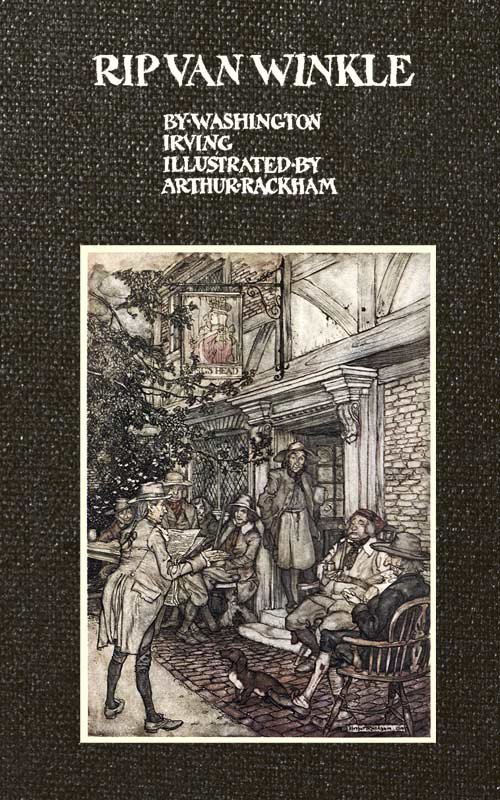
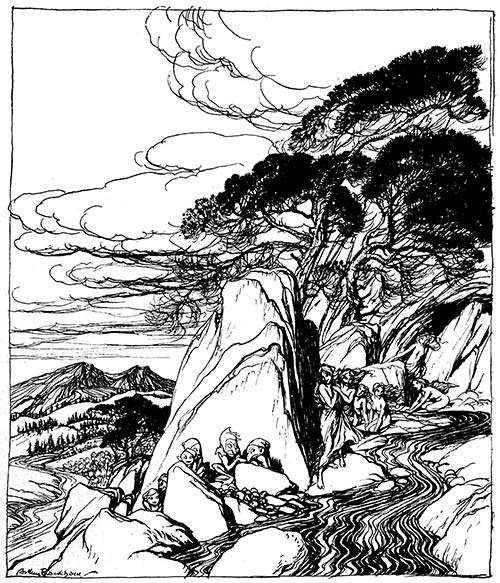
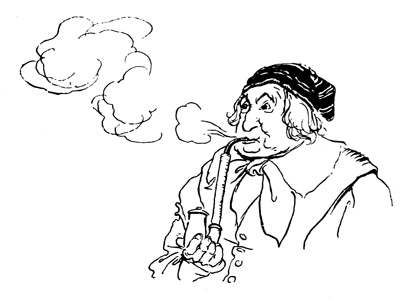
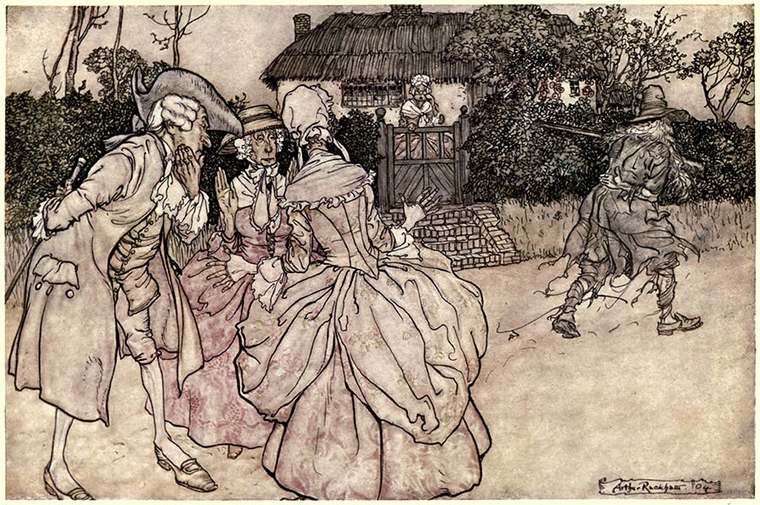
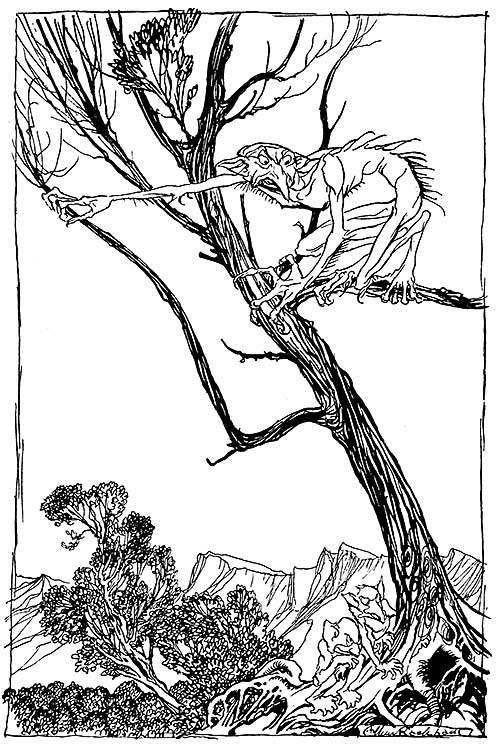
Our edition has the complete tale with Arthur Rackham’s colour plates and drawings, from
Heinemann’s 1916 edition. It keeps Irving’s framing: an introduction by his invented old
historian, Diedrich Knickerbocker, a note in which Knickerbocker swears the story is
true, and a postscript of Catskill legends.
Life when written
Washington Irving was born in New York City in 1783, the youngest of eleven children,
and named after George Washington. In 1815 he went to England to help with his family’s
import business, and when it went bankrupt in 1818 he was staying with his sister Sarah
and her husband in Birmingham. He wrote Rip Van Winkle there that year and turned to
writing for a living.
So he wrote the Catskill mountains from three thousand miles away. The story was
published in 1819 in the first part of The Sketch Book of Geoffrey Crayon, Gent., which
came out in parts in 1819 and 1820, was read on both sides of the Atlantic, and made
Irving the first American writer widely read in Europe. The tale is based on a German
folk tale, and Irving’s own closing note says as much, linking it to “a little German
superstition about the Emperor Frederick der Rothbart.”