01
The fence
Tom conning the neighborhood into paying him to paint his fence is still the funniest scam in American literature — and kids immediately try the logic on their siblings.
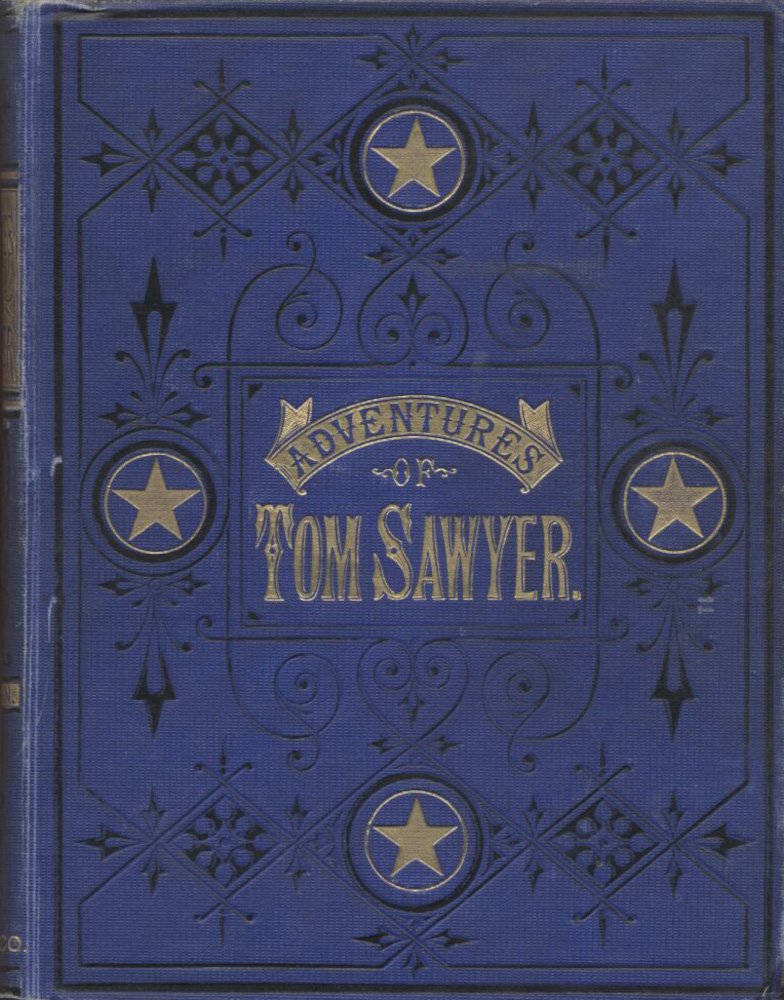
Fence-painting, cave treasure, and attending your own funeral — boyhood mischief's founding text.
EPUB works on any device · two-minute setup guide → ·listening, print & film links go to Amazon (affiliate)
Tom conning the neighborhood into paying him to paint his fence is still the funniest scam in American literature — and kids immediately try the logic on their siblings.
Midnight graveyards, a real murderer, getting lost in a cave — the mischief has stakes, which is why it beats every sanitized imitation.
The fantasy of every kid who ever felt unappreciated, actually staged — and Twain makes it both hilarious and strangely moving.
Tom Sawyer skips school, cons his friends, courts Becky Thatcher, runs away to be a pirate, and — because this is Twain — stumbles into a real murder and real treasure. American boyhood’s founding document, with True Williams’ original 1876 illustrations riding along in our edition.
Twain’s Missouri dialect and 1870s vocabulary ask a little more of readers than the British classics of the same age; call it grade 5 and up. The first half (the fence, church, school) is pure comedy, and the Injun Joe thread pulls the back half into real suspense. Read the content note; the villain’s name and depiction are the book’s 1876 showing, and worth a two-minute conversation before your reader meets him.
Twain wrote it in 1876, in the railroad age, remembering his 1840s boyhood in Hannibal, Missouri — a drowsy town on the Mississippi where the steamboat’s whistle was the event of the day. Boys really did swim the river, explore the caves, and trade treasures out of their pockets; school was one room and discipline was a switch. The book looks back across the Civil War at a river world that had already vanished by the time its first readers opened it.
Modern books (still in copyright, so not free) that scratch the same itch.
Buried treasure, buried secrets, and boys outwitting adults — the modern Newbery classic with Tom's exact DNA.
For the kid who is mostly here for the pranks — modern mischief with Tom Sawyer's spirit and none of the Victorian seasoning.
Affiliate links. They never affect our picks.
Prefer a printed copy? Puffin Classics paperback (affiliate links). Not sure whether your reader needs the original or an abridged edition? Our guide to choosing →
Send the free EPUB to your Kindle with Amazon's free Send to Kindle — it appears in the library like any book.
Opens straight in Apple Books. Tap the file, choose Books, done — great for bedtime read-alouds.
Google Play Books opens it in a couple of taps, and syncs your place across devices.
Apple Books on a Mac, or the free Calibre app on Windows. No account needed.
We shelve it for grades 5–8 — that's where the language and the length sit for a reader on their own. Read aloud, it works earlier, from about age 8–9 — kids follow a story by ear well before they can read it alone.
The unabridged text measures 950L Lexile, AR level 8.1 (12 points). (also listed at 970L.) In everyday terms: grades 5–8, and easier as a read-aloud.
Some — a murder is witnessed, the cave is real fear. The villain is called 'Injun Joe' throughout, a racial caricature of 1876. Tom and Huck witness a murder in chapter 9, and the cave chapters carry real dread. Our edition keeps True Williams' original illustrations.
Yes — the complete, unabridged text, with the original True Williams illustrations. The Adventures of Tom Sawyer was published in 1876, so it's in the US public domain: sharing it free is legal, and there's no signup or catch. We build the ebook ourselves from the original edition.