The pitch
David Balfour, seventeen and newly orphaned, walks to the house of the uncle he has
never met to claim what his father left him. The uncle tries to kill him, fails, and
sells him instead: David wakes clubbed and chained in the hold of a brig bound for the
Carolinas. Then the brig runs down a boat in the fog, and the one survivor hauled
aboard is a Jacobite agent with a belt of French gold and the government’s price on his
head. What follows is a shipwreck, a murder on a public road, and two hundred miles on
foot across the Highlands with soldiers behind them, told by a boy who is not sure,
most of the way, whether the man beside him is his friend or his ruin.
What to know
This is the harder Stevenson. Treasure Island is told in plain English; here the
dialogue is broad Scots — slockens, gliff, kittle, bouman — and that is the
wall a reader hits, usually in chapter two. Stevenson glossed the words himself in
footnotes, and this edition sets each gloss into the sentence where the word appears,
so nothing has to be looked up at the back. Even so it suits confident readers from
about grade 6, and it goes down considerably easier read aloud, where a parent doing
the voices carries the meaning that the spelling hides. It is thirty chapters and about
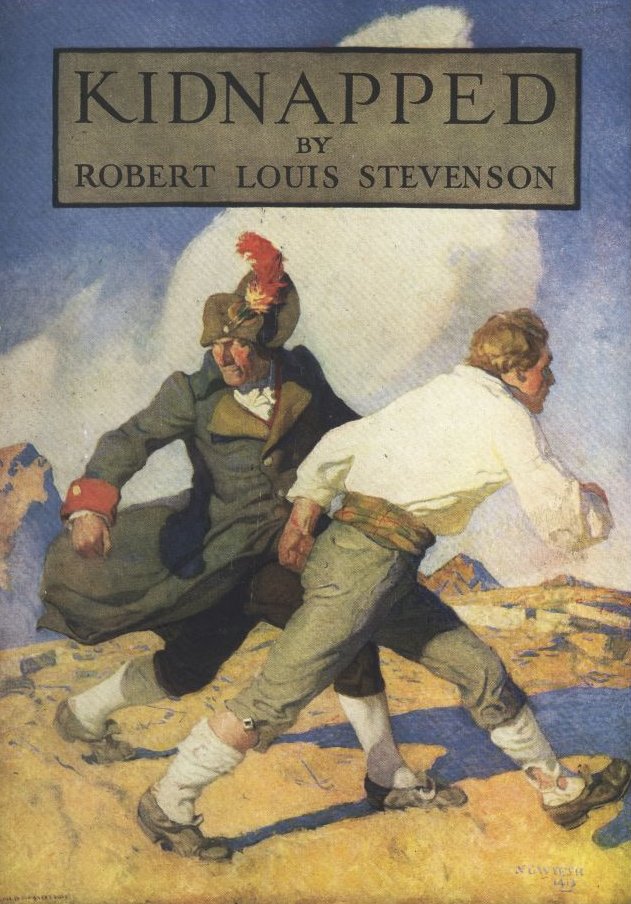
80,000 words. Our edition is the Scribner Illustrated Classics one — N. C. Wyeth’s
1913 paintings, nine of them, plus the fold-out map of the Covenant’s cruise and
David’s route, which is worth having open beside you. Stevenson also wrote a sequel,
Catriona (1893), which picks up on the same afternoon this book ends; two of the
three screen versions borrow from it, and the free text here is Kidnapped alone.
Life when written
Stevenson wrote it at Skerryvore, the house in Bournemouth his father bought for his
wife Fanny, where he lived from 1885 until the doctors ordered him out of Britain
altogether in 1887. He was there because of his lungs. He haemorrhaged repeatedly and
spent long stretches flat on his back, forbidden to move in case the bleeding started
again — so a book that is two hundred miles of heather, scree and river-crossing on
foot was written by a man who could not reliably cross a room, and Strange Case of Dr
Jekyll and Mr Hyde came out of the same rooms in the same eighteen months. The
story itself is not invented: Alan Breck Stewart was a real man, Colin Roy Campbell of
Glenure was really shot near Ballachulish in 1752, and James Stewart was really hanged
for it on evidence that has convinced almost nobody since. It ran first as a serial in
Young Folks, the boys’ magazine that had carried Treasure Island three years
before, and Cassell published it as a book in 1886.