The pitch
A Swiss pastor, his wife Elizabeth and their four sons wake on the seventh day of a
storm to find the ship aground and the crew gone in the only boats. What follows is not
a rescue story. They get ashore in four sawn-up tubs, and then they stay — for ten
years, by choice as much as by accident — and the book is the father’s journal of how
a bare coast became a country. A tent, then a house up a tree, then a home hollowed out
of a wall of rock salt. A bridge, a sledge, a bark canoe, candles made from wax
berries, a loom, a sugar press, a kayak. Four boys who each tame an animal to ride and
argue about whose is best. And somewhere in the middle of it, a boa constrictor comes
out of the marsh and the family loses the donkey. It is the ancestor of every treehouse,
every desert island and every kid who has ever built something out of what was lying
around.
What to know
This is a harder book than the Disney film suggests and an easier one than its
reputation. The sentences are Victorian but they move, and about a third of the book is
four brothers talking — published measures put the full text at 1270L with an ATOS of
9.7, and the AR quiz for the unabridged version is worth 23 points against roughly
117,000 words. Two warnings about shopping for it. The first is abridgement: nearly
every paperback of this title on the market is a retelling, and the 540L-to-610L
figures you will find online belong to those, not to this. The second is translation,
which matters more here than for almost any other classic. Wyss’s German was expanded
in French, and then translated into English half a dozen times by people who felt free
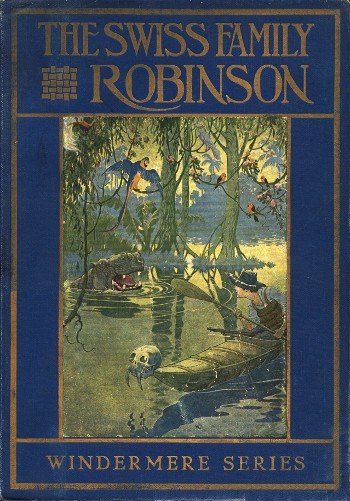
to add and cut; the versions differ by whole chapters. Ours is W. H. G. Kingston’s 1879
text, which is the one nearly every modern edition uses, taken from the 1916 Rand
McNally Windermere printing — and we checked it against a second complete edition
before building it, because the most widely circulated alternative is missing the pearl
fishery, the ostriches, the walrus and the albatross entirely. The chapters are the
edition’s own, and they are long: eighteen of them, averaging about 6,800 words, which
is roughly twenty-five minutes of reading aloud. They have proper titles, so you can see
where you are, but plan a stopping point rather than being caught by one. The
illustrations are Milo Winter’s fourteen colour plates, and there is a story in them:
the copy Project Gutenberg transcribed is a reduced printing carrying only eight, so we
took all fourteen from a full copy of the same edition and put each one where the book’s
own list of illustrations says it belongs. The six that Gutenberg’s copy is missing
include the boa closing on the donkey, which is the most reproduced picture in the book.
Read the content note before you hand this over: the animal killing is relentless, and
the religious frame is the whole architecture rather than a decoration on it.
Life when written
Johann David Wyss was a pastor in Bern and an army chaplain, and he made the story up
for his own four sons somewhere between 1794 and 1798, telling it to them episode by
episode — which is why the book reads like a serial and why the four boys in it behave
like four boys somebody actually knew. Those were not calm years to be a father in
Bern. French troops crossed into Switzerland on 5 March 1798, the old Confederacy
collapsed within weeks, and the Helvetic Republic that replaced it was resented above
all for what it did to religious practice. Wyss put the manuscript away. It was his son
Johann Rudolf — professor of philosophy at Bern, and fresh from writing the words of
Rufst du, mein Vaterland, a war song for Swiss gunners set to the tune of God Save
the King that Switzerland then kept as its national anthem until 1961 — who edited the
manuscript and got it printed in 1812 and 1813; another son, Johann Emmanuel, drew the
pictures. Their father lived to see it become the most translated Swiss book ever
written and died in 1818, and the
family’s own peculiar arrangement is stamped on every page of it: a father who cannot
watch his sons find a plant without explaining it, and four sons who keep interrupting.