01
Everyone finds their sister
Responsible Meg, wild Jo, gentle Beth, dramatic Amy — a century and a half of readers have sorted themselves into Marches. Kids still do.
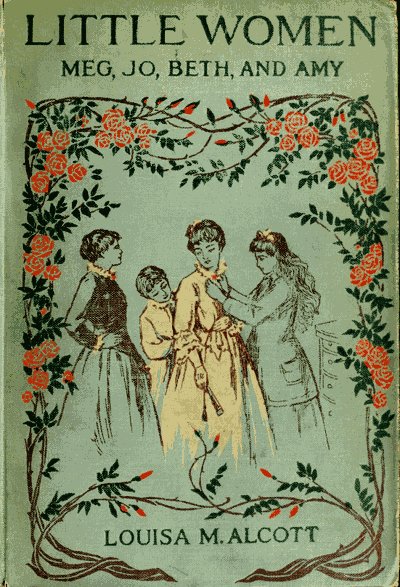
Four sisters, one genius portrait of growing up — with two hundred original illustrations in this edition.
EPUB works on any device · two-minute setup guide → ·listening, print & film links go to Amazon (affiliate)
Responsible Meg, wild Jo, gentle Beth, dramatic Amy — a century and a half of readers have sorted themselves into Marches. Kids still do.
Ink-stained, temper-prone, selling stories and refusing to be a lady about it — still one of the most alive characters in American fiction.
A burned manuscript, a ball gone wrong, a telegram from the war — the book proves ordinary family life is drama enough.
Meg, Jo, Beth, and Amy March grow up genteel-poor in Civil War New England — putting on plays in the attic, feuding, falling in love, and losing what cannot be kept. It is the great American family novel, and this edition carries Frank T. Merrill’s two hundred original illustrations, the ones Alcott herself approved.
This is the longest book on our shelf, and the oldest in feel; the March girls speak in a moral register from another century. It belongs to strong middle-school readers and up, and it rewards patience. The first half is episodic comfort, and the second half grows up alongside its characters. Know where the famous sad chapter falls before your reader gets there. A century and a half has not softened it.
Alcott wrote in Concord, Massachusetts in 1868, three years after the Civil War ended — a father away at the front, like Mr. March, had been the recent reality of thousands of households. The Alcotts were genteel-poor among famous neighbors (Emerson and Thoreau were family friends), and Louisa herself had served as a Union army nurse. Meg, Jo, Beth, and Amy are her own sisters barely disguised; the March parlor, with its plays and privations, is essentially hers.
Modern books (still in copyright, so not free) that scratch the same itch.
A big, warm, chaotic family in a beloved house — the March formula alive and well in modern Harlem.
Four modern girls read Little Women together and live it — the perfect companion read, and a book-club starter kit.
Affiliate links. They never affect our picks.
Prefer a printed copy? Puffin Classics paperback (affiliate links). Not sure whether your reader needs the original or an abridged edition? Our guide to choosing →
Send the free EPUB to your Kindle with Amazon's free Send to Kindle — it appears in the library like any book.
Opens straight in Apple Books. Tap the file, choose Books, done — great for bedtime read-alouds.
Google Play Books opens it in a couple of taps, and syncs your place across devices.
Apple Books on a Mac, or the free Calibre app on Windows. No account needed.
We shelve it for grades 6–9 — that's where the language and the length sit for a reader on their own. Read aloud, it works earlier, from about age 8–9 — kids follow a story by ear well before they can read it alone.
The unabridged text measures 1260L Lexile, AR level 7.9 (33 points). (the complete Books I and II; editions measure 1190L-1300L.) In everyday terms: grades 6–9, and easier as a read-aloud.
None — but the saddest chapter in the classics. You likely know the one big spoiler; your reader may not. Generations of readers have done their first real grieving over Beth's story. Period piety and gender expectations run throughout, as they did in 1868.
Yes — the complete, unabridged text, with the original Frank T. Merrill illustrations. Little Women was published in 1868, so it's in the US public domain: sharing it free is legal, and there's no signup or catch. We build the ebook ourselves from the original edition.