HomeAll booksRebecca of Sunnybrook Farm
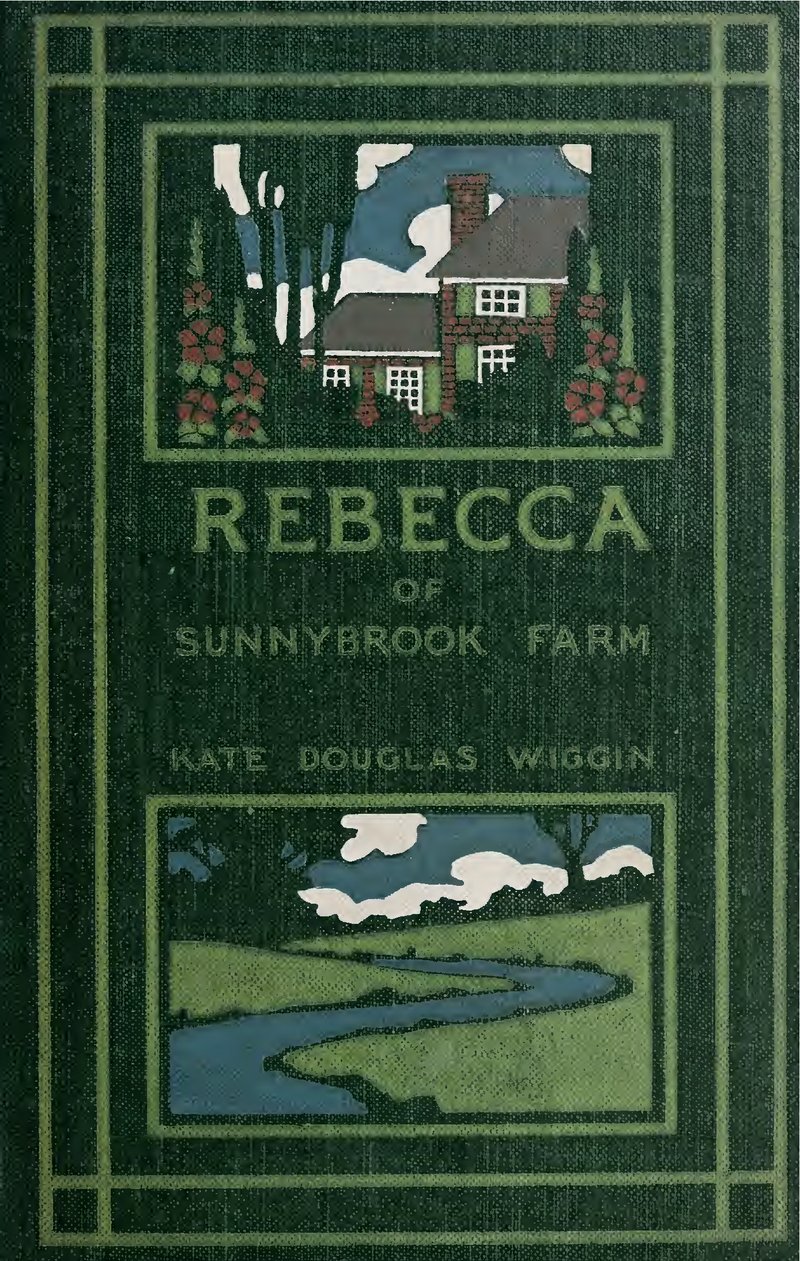
Rebecca of Sunnybrook Farm cover
School & family

Rebecca of Sunnybrook Farm

Kate Douglas Wiggin · first published 1903

Two aunts send for their sensible niece Hannah to raise in the brick house — and the farm sends Rebecca instead, ten years old, all eyes and imagination, talking before the stage coach clears the first hill.

Free EPUB & KindleGrades 5–8
Worth knowing ⓘ
Worth knowing: Rebecca's father died when she was seven, leaving a mortgaged farm and seven children; that is why she is sent away. Mira, the baby of the family, dies in chapter 17, and Rebecca goes home for the funeral. In the last chapters aunt Miranda suffers two strokes and dies suddenly in chapter 30, while Rebecca is at Sunnybrook nursing her mother, who has fallen from a haymow and injured her knee and back; the book ends after the funeral, with Rebecca inheriting the brick house. Church runs through the whole story — hymns are quoted at length, and chapters 18–20 turn on a missionary couple home from Syria, with period hymn lines about 'the heathen in his blindness.' Dated vocabulary appears in dialogue: a neighbor says Rebecca looks 'black as an Injun' in chapter 1, the children play log-cabin games against 'hostile Indians' in chapter 6, and Miranda alludes to the 'good Indian' proverb in chapter 9. Adam Ladd, a bachelor of thirty-four when he first meets ten-year-old Rebecca in chapter 14, becomes her benefactor for the rest of the book — three hundred cakes of soap, Christmas gifts, an essay prize at her school. Rebecca is seventeen when the book ends, and the last chapter calls her future 'close-folded still.'

EPUB works on any device · two-minute setup guide → ·listening, print & film links go to Amazon (affiliate)

Why your kid will love it

01

She out-talks every grown-up in Maine

Rebecca's first ride to Riverboro is one long monologue delivered from the top of the stage coach — her pink parasol, her six brothers and sisters, the mortgage, her plans — while old Mr. Cobb decides she is the best company he has ever carried. Kids recognize the voice at once: it is what being ten sounds like from the inside.

02

The great soap campaign

To win a premium banquet lamp for the Simpson kids — a family too poor to buy kerosene — Rebecca and Emma Jane go door to door selling soap, and Rebecca talks a stranger on a porch into buying three hundred cakes. It is the book's best scene because an adult finally takes a kid's scheme completely seriously.

03

Her poems are terrible, and the book prints them

Rebecca writes verse the way other kids skip stones — constantly, about everything — and the book sets her poems down exactly as she spells them, 'gardian angel' and all. A kid who has ever written half a story in a notebook will feel personally seen.

Reading it together?

Warm-ups, real questions, and something to do together. No worksheets.Book club questions →

The background for parents

The pitch

The brick-house aunts of Riverboro write to their widowed sister asking for Hannah, the quiet, useful niece — and get Rebecca instead, ten years old, dark-eyed, arriving on top of the stage coach mid-monologue with a pink parasol and six siblings’ worth of stories. What follows is seven years of collision between a child who makes the world larger everywhere she looks and an aunt who believes the world should hold still. Mark Twain called it “beautiful and warm and satisfying,” and he was reviewing the exact thing kids still find in it: a heroine who wins not by being good but by being unmistakably herself.

What to know

This is the book Anne of Green Gables learned from — it came five years earlier, and families who love Anne will recognize the species: the talker nobody ordered, the stern guardian, the small town slowly colonized. The prose is a real step up from Pollyanna’s — long, ornate, Victorian sentences that measure at about an eighth-grade level, so it suits a strong independent reader from grade 5 up and reads aloud beautifully at eight or nine, Yankee dialect and all. The chapters are episodic — soap sales, school compositions, a missionary evening that goes sideways — which makes it a natural chapter-a-night book. Two deaths come late (the content note has the specifics), and the ending is the quietest, most grown-up stretch of the story. Our edition is the complete 1903 text including Wiggin’s dedication to her mother; the 1903 Houghton Mifflin first edition carried no interior plates, so this ships as text with the edition’s own green pictorial cover. Wiggin wrote a sequel of linked stories, New Chronicles of Rebecca, in 1907.

Life when written

Kate Douglas Wiggin spent her childhood in Hollis, Maine, in a village on the Saco River that she would rename Riverboro, and wrote Rebecca there half a century later, at her family house Quillcote — summers on one side of the continent describing the other, because by then she was famous in California as an educator: in 1878 she had founded San Francisco’s first free kindergarten, on Silver Street, and she wrote her early books partly to fund it. The Maine she gives Rebecca is the one she knew in the 1860s and 70s — stage coaches surviving alongside the new railroads, one-room schoolhouses, church socials, and soap companies that ran premium schemes exactly like the one in the book, where enough cakes sold really would earn a family a banquet lamp. The book was the bestselling novel Houghton Mifflin had printed in years, went to Broadway as a play in 1910, and made Rebecca a household name for two generations — which is how, by 1938, Hollywood could borrow the title for a Shirley Temple musical without keeping the story, correctly betting that every parent in America already knew the real one.
The book vs. the movie

Hollywood filmed it three times and never once filmed the book — the 1938 version turns Rebecca into a radio star. What no film touches is the book's real engine: a child talking her way, year by year, past a stone wall of an aunt.How they differ →

If they like it, read these next

Modern books (still in copyright, so not free) that scratch the same itch.

The Penderwicks by Jeanne Birdsall

For the kid who liked Rebecca's world — scrapes, sisters, small stakes that feel enormous — in modern dress. Birdsall wrote it deliberately in the old warm register, and it reads like Riverboro with a station wagon.

Turtle in Paradise by Jennifer L. Holm

Another girl shipped off to relatives who didn't exactly ask for her — Key West, 1935 — for the kid who liked watching Rebecca win over a household that started out cold. Turtle is saltier than Rebecca, and a grade easier to read.

Affiliate links. They never affect our picks.

Prefer a printed copy? Dover Children's Evergreen Classics paperback (affiliate links). Not sure whether your reader needs the original or an abridged edition? Our guide to choosing →

Read it on any device

Quick answers

What age is Rebecca of Sunnybrook Farm right for?

We shelve it for grades 5–8 — that's where the language and the length sit for a reader on their own. Read aloud, it works earlier, from about age 8–9 — kids follow a story by ear well before they can read it alone.

What reading level is Rebecca of Sunnybrook Farm?

The unabridged text measures 1160L Lexile, AR level 8.1 (13 points). (the unabridged edition measures 1160L, and full-text editions run 1130L–1190L; the 680L and 960L entries in circulation are abridged retellings.) In everyday terms: grades 5–8, and easier as a read-aloud.

Is Rebecca of Sunnybrook Farm scary?

None — but deaths in the family; see note. Rebecca's father died when she was seven, leaving a mortgaged farm and seven children; that is why she is sent away. Mira, the baby of the family, dies in chapter 17, and Rebecca goes home for the funeral. In the last chapters aunt Miranda suffers two strokes and dies suddenly in chapter 30, while Rebecca is at Sunnybrook nursing her mother, who has fallen from a haymow and injured her knee and back; the book ends after the funeral, with Rebecca inheriting the brick house. Church runs through the whole story — hymns are quoted at length, and chapters 18–20 turn on a missionary couple home from Syria, with period hymn lines about 'the heathen in his blindness.' Dated vocabulary appears in dialogue: a neighbor says Rebecca looks 'black as an Injun' in chapter 1, the children play log-cabin games against 'hostile Indians' in chapter 6, and Miranda alludes to the 'good Indian' proverb in chapter 9. Adam Ladd, a bachelor of thirty-four when he first meets ten-year-old Rebecca in chapter 14, becomes her benefactor for the rest of the book — three hundred cakes of soap, Christmas gifts, an essay prize at her school. Rebecca is seventeen when the book ends, and the last chapter calls her future 'close-folded still.'

Is the free ebook really the whole book?

Yes — the complete, unabridged text. Rebecca of Sunnybrook Farm was published in 1903, so it's in the US public domain: sharing it free is legal, and there's no signup or catch. We build the ebook ourselves from the original edition.

More free classics like this