01
The pictures carry the story
More than 250 of Potter's own watercolors, one facing nearly every page of text. A child who can't read a word still follows every turn of the plot.
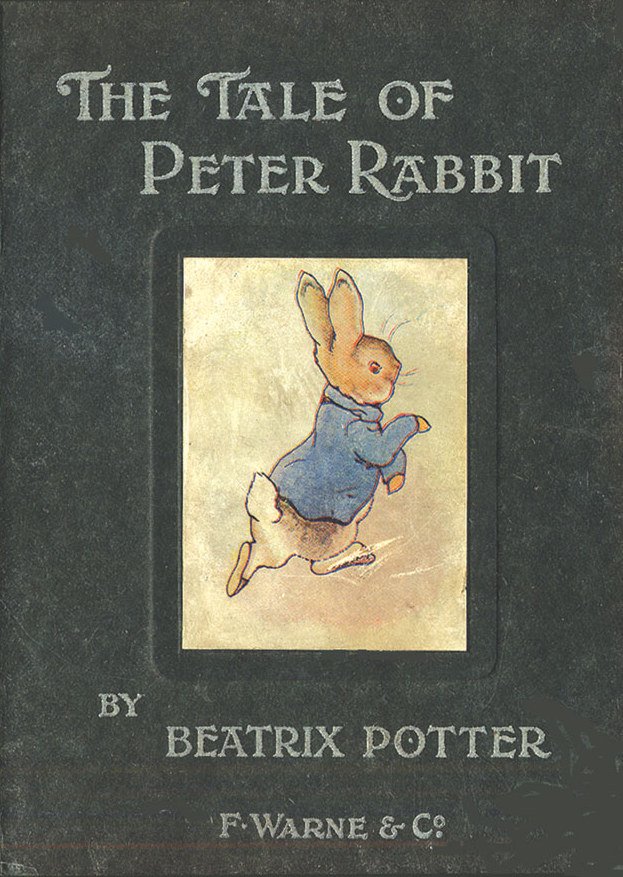
Ten complete tales with a painting on nearly every page — small enough that a child who cannot read yet can hold the whole story in their head.
EPUB works on any device · two-minute setup guide → ·listening, print & film links go to Amazon (affiliate)
More than 250 of Potter's own watercolors, one facing nearly every page of text. A child who can't read a word still follows every turn of the plot.
Peter's father was put in a pie by Mrs. McGregor. Potter says it once, plainly, in the third sentence — and the whole escape is finished before a small listener runs out of attention.
Peter turns up in Benjamin Bunny's tale; Jemima's ducks wander into Tom Kitten's. Ten small stories, one small world, and children start spotting the crossings themselves.
A rabbit in a blue jacket squeezes under a garden gate his father never came back from. Ten complete tales follow — a squirrel who taunts an owl until it costs him his tail, a duck who trusts a fox, two mice who wreck a doll’s house over a ham made of plaster — each about a thousand words, each with a painting of Potter’s own on nearly every page.
These are picture books and we have kept them that way: 262 of Potter’s watercolors, at full size, facing the text the way she arranged them. A child of six can read a tale alone, and a child of three can follow it in your lap, which is why this one carries the parent-reads tag. Her sentences are short but her words are not simplified (a rabbit is “implored to exert himself”), and children take that vocabulary in happily when it arrives in the middle of a chase. Ten of Potter’s twenty-three little books are here, all from her first decade, 1902 to 1909. The complete set is a fine thing to own on paper.
Potter was twenty-seven, living where an unmarried daughter of her class was expected to live — her parents’ house in West Brompton, London — and on holiday in Scotland when she heard that Noel Moore, the five-year-old son of her former governess, was recovering from scarlet fever. On 4 September 1893 she sent him an eight-page illustrated letter, opening: “I don’t know what to write to you, so I shall tell you a story about four little rabbits.” Four years later the Linnean Society would not let her read her own paper on fungus spores in the room; a man read it aloud for her, because she was a woman. At least six publishers turned down Peter Rabbit, so she printed it herself in 1901; Warne took it in 1902, and by 1905 the little books had bought her a farm in the Lake District.
Modern books (still in copyright, so not free) that scratch the same itch.
A small animal talks its way past everything that wants to eat it — Potter's exact machinery, in rhyme, for the same age.
Illustrated animal comedy in short chapters, for the child who finishes these ten and wants a longer one at the same size.
Affiliate links. They never affect our picks.
Prefer a printed copy? All 23 tales (Warne hardcover) (affiliate links). Not sure whether your reader needs the original or an abridged edition? Our guide to choosing →
Send the free EPUB to your Kindle with Amazon's free Send to Kindle — it appears in the library like any book.
Opens straight in Apple Books. Tap the file, choose Books, done — great for bedtime read-alouds.
Google Play Books opens it in a couple of taps, and syncs your place across devices.
Apple Books on a Mac, or the free Calibre app on Windows. No account needed.
We shelve it for grades K–2 — that's where the language and the length sit for a reader on their own. Read aloud, it works earlier, from about age 3–4 — kids follow a story by ear well before they can read it alone.
The unabridged text measures AD660L Lexile, AR level 4.2 (0.5 points), guided reading level L. (for The Tale of Peter Rabbit itself; the other tales run roughly 600L-900L.) In everyday terms: grades K–2, and easier as a read-aloud.
Mild — but the danger is real and named. Potter never pretends the countryside is safe. Peter's father was baked in a pie, Jemima Puddle-Duck's charming host is a fox who is planning dinner, and Mr. McGregor means to sell the Flopsy Bunnies' skins. Each of these is said once, matter-of-factly, and every animal gets away.
Yes — the complete, unabridged text, with the original Beatrix Potter illustrations. The Tale of Peter Rabbit and Other Stories was published in 1902, so it's in the US public domain: sharing it free is legal, and there's no signup or catch. We build the ebook ourselves from the original edition.