The pitch
Pollyanna Whittier arrives in Beldingsville, Vermont, with a trunk the Ladies’
Aid bought her and one thing her father left behind: a game. You find the thing
to be glad about in whatever has just happened, and the harder that is, the
better it counts. She plays it at an aunt who has given her the bare attic room
out of duty, at an invalid who has not left her bed in years, at a recluse whose
gate nobody opens — and then, two-thirds of the way through, something happens
that she cannot play it at, and the book stops and stays there with her.
What to know
Thirty-two short chapters, written as a weekly serial, so each one arrives with
its own shape and its own ending: this is a book built for a chapter a night.
The dialect is the work. Nancy the kitchen maid talks in thick New England
vernacular — “I ain’t sayin’ that I’ll play it very well, and I ain’t sayin’
that I know how, anyway; but I’ll play it with ye, after a fashion — I just
will, I will!” — and reading her aloud is most of the fun and all of the
difficulty. A confident grade-4 reader handles the prose; the dialect is the
part that may want a grown-up nearby. Worth knowing before you start: for a
century “Pollyanna” has been an insult, shorthand for someone who won’t look at
anything wrong, and the girl in the book is a poorer fit for that word than the
word suggests. Our edition is the complete 1913 text, including Porter’s
dedication to her cousin Belle. Stockton Mulford illustrated the first edition,
but the only open scans of his plates are grey halftones from a later printing,
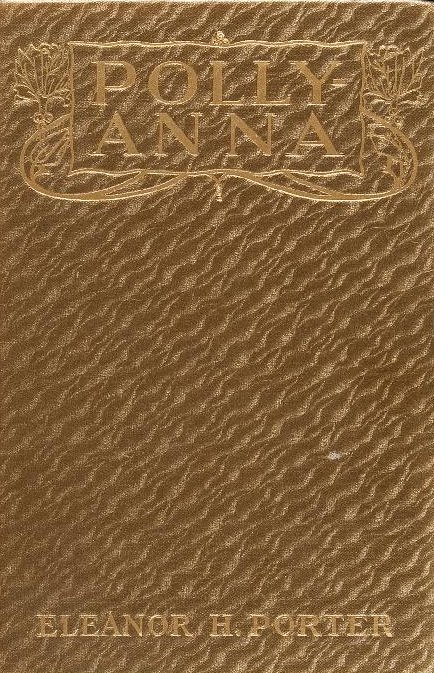
so this ships as text and cover only; the cover is the 1913 L. C. Page front
board itself, gold stamped on brown ribbed cloth. The last third turns on an
accident — the content note has the specifics.
Life when written
Eleanor Hodgman Porter was born in Littleton, New Hampshire, in 1868, trained
as a singer at the New England Conservatory, and only turned to fiction after
she married in 1892 and moved to Massachusetts. She wrote Pollyanna as a weekly
serial for The Christian Herald, a religious newspaper, across 1912 and 1913 —
which is why it moves in episodes, and why church is in every corner of it. The
missionary barrel that clothes Pollyanna, and that sends crutches the year she
asked for a doll, was a real institution: women’s societies in comfortable
eastern congregations packed barrels of used clothes, books and food and shipped
them west to underpaid ministers, who unpacked whatever turned up. The book sold
enormously — eighth on the American bestseller list in 1913, second in 1914 —
and a 1920 copy scanned by the University of North Carolina prints its own
history on the copyright page: first impression February 1913, forty-seventh
impression February 1920, four hundred and seventy thousand copies. Porter died
three months after that printing, at fifty-one.