The Frogs Asking for a King.
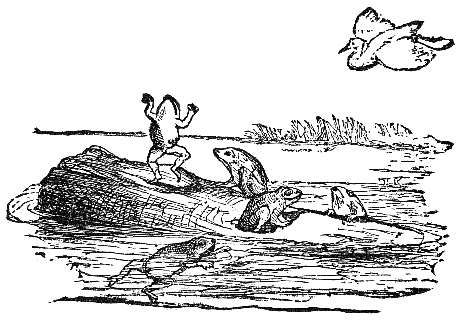
The Frogs, grieved at having no established Ruler, sent ambassadors to Jupiter entreating for a King. He, perceiving their simplicity, cast down a huge log into the lake. The Frogs, terrified at the splash occasioned by its fall, hid themselves in the depth of the pool. But no sooner did they see that the huge log continued motionless, than they swam again to the top of the water, dismissed their fears, and came so to despise it as to climb up, and to squat upon it. After some time they began to think themselves ill-treated in the appointment of so inert a Ruler, and sent a second deputation to Jupiter to pray that he would set over them another sovereign. He then gave them an Eel to govern them. When the Frogs discovered his easy good-nature, they yet a third time sent to Jupiter to beg that he would once more choose for them another King. Jupiter, displeased at their complaints, sent a Heron, who preyed upon the Frogs day by day, till there were none left to complain.
When you seek to change your condition, be sure that you can better it.
The Prophet.
A Wizard, sitting in the market-place, told the fortunes of the passers-by. A person ran up in great haste, and announced to him that the doors of his house had been broken open, and that all his goods were being stolen. He sighed heavily, and hastened away as fast as he could run. A neighbor saw him running, and said: "Oh! you follow those? you say you can foretell the fortunes of others; how is it you did not foresee your own?"
The Dog and his Master's Dinner.
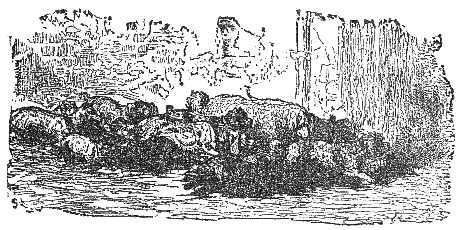
A Dog had been taught to take his master's dinner to him every day. As he smelled the good things in the basket, he was sorely tempted to taste them, but he resisted the temptation and continued day after day to carry the basket faithfully. One day all the dogs in the neighborhood followed him with longing eyes and greedy jaws, and tried to steal the dinner from the basket. At first the faithful dog tried to run away from them, but they pressed him so close that at last he stopped to argue with them. This was what the thieves desired, and they soon ridiculed him to that extent that he said: "Very well, I will divide with you," and he seized the best piece of chicken in the basket, and left the rest for the others to enjoy.
He who stops to parley with temptation, will be very likely to yield.
The Buffoon and the Countryman.
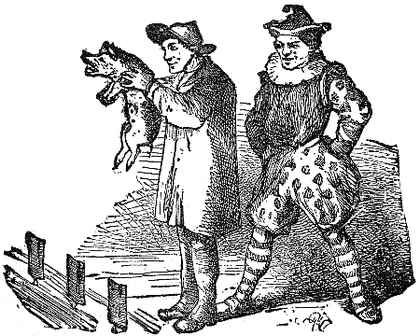
A rich nobleman once opened the theater to the public without charge, and gave notice that he would handsomely reward any one who would produce a new amusement. A Buffoon, well known for his jokes, said that he had a kind of entertainment that had never been produced in a theater. This report, being spread about, created a great stir in the place, and the theater was crowded to see the new entertainment. The Buffoon appeared, and imitated the squeaking of a little pig so admirably with his voice, that the audience declared that he had a porker under his cloak, and demanded that it should be shaken out. When that was done, and yet nothing was found, they cheered the actor, with the loudest applause. A countryman in the crowd proclaimed that he would do the same thing on the next day. On the morrow a still larger crowd assembled in the theater. Both of the performers appeared on the stage. The Buffoon grunted and squeaked, and obtained, as on the preceding day, the applause and cheers of the spectators. Next the Countryman commenced, and pretending that he concealed a little pig beneath his clothes (which in truth he did), contrived to lay hold of and to pull his ear, when he began to squeak. The crowd, however, cried out that the Buffoon had given a far more exact imitation. On this the Rustic produced the pig, and showed them the greatness of their mistake.
Critics are not always to be depended upon.
The Boar and the Ass.
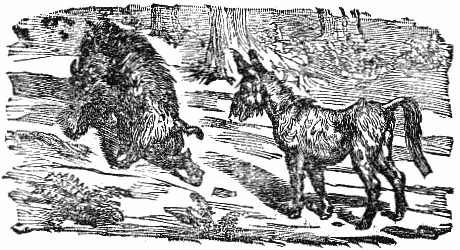
A little scoundrel of an Ass, happening to meet with a Boar, had a mind to be arch upon him, and so, says he: "Your humble servant." The Boar, somewhat nettled at his familiarity, bristled up to him, and told him he was surprised to hear him utter so impudent an untruth, and was just going to show his resentment by giving him a rip in the flank; but wisely stifling his passion, he contented himself with saying: "Go, you sorry beast! I do not care to foul my tusks with the blood of so base a creature."
Dignity cannot afford to quarrel with its inferiors.
The Fox and the Goat.
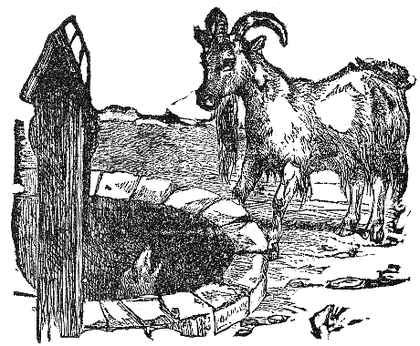
A Fox, having fallen into a well, could find no means of escape. A Goat, overcome with thirst, came to the well, and, seeing the Fox, inquired if the water was good. The Fox, concealing his sad plight under a merry guise, indulged in lavish praise of the water, saying it was beyond measure excellent, and encouraged him to descend. The Goat, mindful only of his thirst, thoughtlessly jumped down, when, just as he quenched his thirst, the Fox informed him of the difficulty they were both in, and suggested a scheme for their common escape. "If," said he, "you will place your fore-feet upon the wall, and bend your head, I will run up your back and escape, and will help you out." On the Goat readily assenting to this proposal, the Fox leaped upon his back, and steadying himself with the goat's horns reached in safety the mouth of the well, and immediately made off as fast as he could. The Goat upbraided him with the breach of his bargain, when he turned round and cried out: "You foolish fellow! If you had as many brains in your head as you have hairs in your beard, you would never have gone down before you had inspected the way up, nor have exposed yourself to dangers from which you had determined upon no means of escape."
Look before you leap.
The Oxen and the Butchers.
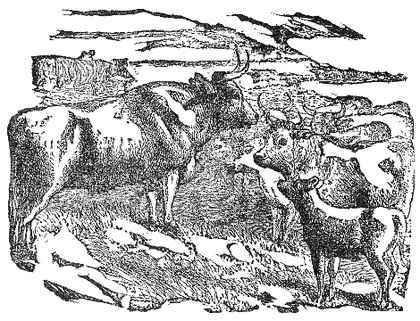
The Oxen, once on a time, sought to destroy the Butchers, who practiced a trade destructive to their race. They assembled on a certain day to carry out their purpose, and sharpened their horns for the contest. One of them, an exceedingly old one (for many a field had he ploughed), thus spoke: "These Butchers, it is true, slaughter us, but they do so with skillful hands, and with no unnecessary pain. If we get rid of them, we shall fall into the hands of unskillful operators, and thus suffer a double death; for you may be assured that, though all the Butchers should perish, yet will men never want beef."
Do not be in a hurry to change one evil for another.
The Horse and his Rider.
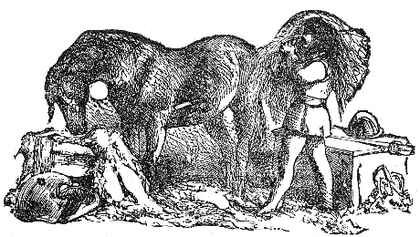
A Horse-soldier took great pains with his charger. As long as the war lasted, he looked upon him as his fellow-helper in all emergencies, and fed him carefully with hay and corn. When the war was over, he only allowed him chaff to eat, and made him carry heavy loads of wood, and subjected him to much slavish drudgery and ill-treatment. War, however, being again proclaimed, the Soldier put on his charger its military trappings, and mounted, being clad in his heavy coat of mail. The Horse fell down straightway under the weight, no longer equal to the burden, and said to his master: "You must now e'en go to the war on foot, for you have transformed me from a Horse into an Ass."
He who slights his friends when they are not needed must not expect them to serve him when he needs them.