The Camel and the Travelers.
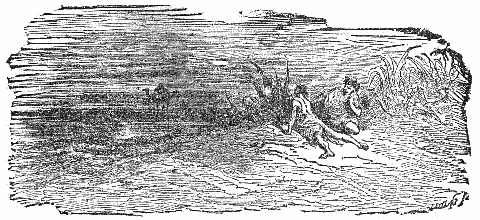
Two Travelers on a desert saw a Camel in the distance, and were greatly frightened at his huge appearance, thinking it to be some huge monster. While they hid behind some low shrubs, the animal came nearer, and they discovered that it was only a harmless Camel which had excited their fears.
Distance exaggerates dangers.
The Swan and the Goose.
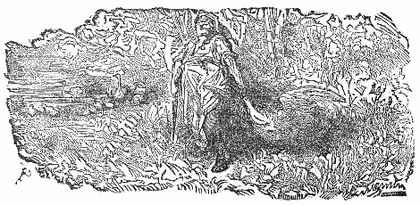
A certain rich man bought in the market a Goose and a Swan. He fed the one for his table, and kept the other for the sake of its song. When the time came for killing the Goose, the cook went to take him at night, when it was dark, and he was not able to distinguish one bird from the other, and he caught the Swan instead of the Goose. The Swan, threatened with death, burst forth into song, and thus made himself known by his voice, and preserved his life by his melody.
Sweet words may deliver us from peril, when harsh words would fail.
The Dolphins and the Sprat.
The Dolphins and the Whales were at war with one another, and the Sprat stepped in and endeavored to separate them. But one of the Dolphins cried out: "We would rather perish in the contest, than be reconciled by you."
The Shepherd and the Sea.
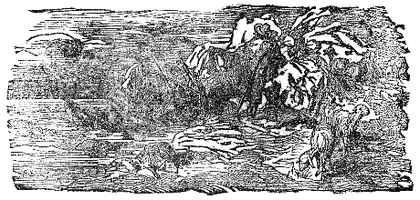
A Shepherd moved down his flock to feed near the shore, and beholding the Sea lying in a smooth calm, he was seized with a strong desire to sail over it. So he sold all his sheep and bought a cargo of Dates, and loaded a vessel, and set sail. He had not gone far when a storm arose; his ship was wrecked, and his Dates and everything lost, and he himself with difficulty escaped to land. Not long after, when the Sea was again calm, and one of his friends came up to him and was admiring its repose, he said: "Have a care, my good fellow, of that smooth surface, it is only looking out for your Dates."
The Bees, the Drones, and the Wasp.
Some Bees had built their comb in the hollow trunk of an oak. The Drones asserted that it was their doing, and belonged to them. The cause was brought into court before Judge Wasp. Knowing something of the parties, he thus addressed them: "The plaintiffs and defendants are so much alike in shape and color as to render the ownership a doubtful matter. Let each party take a hive to itself, and build up a new comb, that from the shape of the cells and the taste of the honey, the lawful proprietors of the property in dispute may appear." The Bees readily assented to the Wasp's plan. The Drones declined it. Whereupon the Wasp gave judgment: "It is clear now who made the comb, and who cannot make it; the Court adjudges the honey to the Bees."
Professions are best tested by deeds.
The Wolf, the Goat and the Kid.
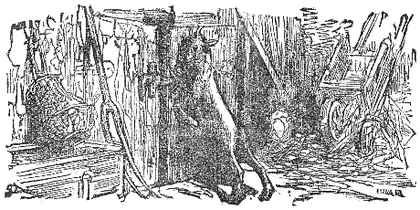
As an old Goat was going forth to pasture, she carefully latched her door, and bid her kid not to open it to any one who could not give this pass-word: "Beware of the Wolf and all his race." A Wolf happened to be passing, and overheard what the old Goat said. When she was gone, he went to the door, and, knocking, said: "Beware of the Wolf and all his race." But the Kid, peeping through a crack, said: "Show me a white paw and I will open the door." As the Wolf could not do this, he had to depart, no better than he came.
Two sureties are better than one.
The Fox and the Hedgehog.
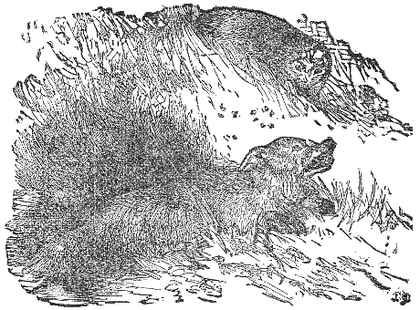
A Fox, while crossing over a river, was driven by the stream into a narrow gorge, and lay there for a long time unable to get out, covered with myriads of horse-flies that had fastened themselves upon him. A Hedgehog, who was wandering in that direction, saw him, and taking compassion on him, asked him if he should drive away the flies that were so tormenting him. But the Fox begged him to do nothing of the sort. "Why not?" asked the Hedgehog. "Because," replied the Fox, "these flies that are upon me now are already full, and draw but little blood, but should you remove them, a swarm of fresh and hungry ones will come, who will not leave a drop of blood in my body."
When we throw off rulers or dependents, who have already made the most of us, we do but, for the most part, lay ourselves open to others, who will make us bleed yet more freely.
The Brazier and His Dog.
A Brazier had a little Dog, which was a great favorite with his master, and his constant companion. While he hammered away at his metals the Dog slept; but when, on the other hand, he went to dinner, and began to eat, the Dog woke up, and wagged his tail, as if he would ask for a share of his meal. His master one day, pretending to be angry, and shaking his stick at him, said: "You wretched little sluggard! what shall I do to you? While I am hammering on the anvil, you sleep on the mat, and when I begin to eat after my toil, you wake up and wag your tail for food. Do you not know that labor is the source of every blessing, and that none but those who work are entitled to eat?"
The Wild Ass and the Lion.
A Wild Ass and a Lion entered into an alliance that they might capture the beasts of the forest with the greater ease. The Lion agreed to assist the Wild Ass with strength, while the Wild Ass gave the Lion the benefit of his greater speed. When they had taken as many beasts as their necessities required, the Lion undertook to distribute the prey, and for this purpose divided it into three shares. "I will take the first share," he said, "because I am king; and the second share, as a partner with you in the chase; and the third share (believe me) will be a source of great evil to you, unless you willingly resign it to me, and set off as fast as you can."
Might makes right.
The Father and His Two Daughters.
A man had two daughters, the one married to a gardener, and the other to a tile-maker. After a time he went to the daughter who had married the gardener, and inquired how she was, and how all things went with her. She said: "All things are prospering with me, and I have only one wish, that there may be a heavy fall of rain, in order that the plants may be well watered." Not long after he went to the daughter who had married the tile-maker, and likewise inquired of her how she fared; she replied: "I want for nothing, and have only one wish, that the dry weather may continue, and the sun shine hot and bright, so that the bricks might be dried." He said to her: "If your sister wishes for rain, and you for dry weather, with which of the two am I to join my wishes?"