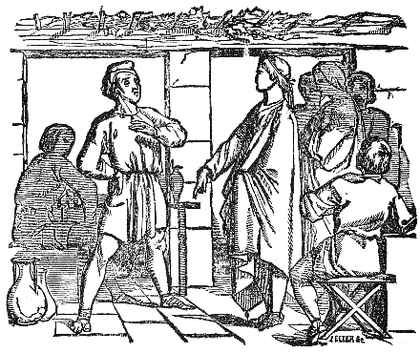
The Dogs and the Fox.
Some Dogs, finding the skin of a lion, began to tear it in pieces with their teeth. A Fox, seeing them, said: "If this lion were alive, you would soon find out that his claws were stronger than your teeth."
It is easy to kick a man that is down.
The Thief and the House-Dog.
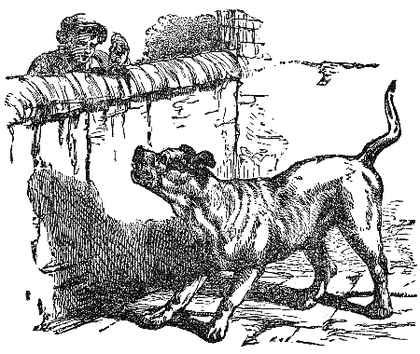
A Thief came in the night to break into a house. He brought with him several slices of meat, that he might pacify the House-dog, so that he should not alarm his master by barking. As the Thief threw him the pieces of meat, the Dog said: "If you think to stop my mouth, to relax my vigilance, or even to gain my regard by these gifts, you will be greatly mistaken. This sudden kindness at your hands will only make me more watchful, lest under these unexpected favors to myself you have some private ends to accomplish for your own benefit, and for my master's injury. Besides, this is not the time that I am usually fed, which makes me all the more suspicions of your intentions."
He who offers bribes needs watching, for his intentions are not honest.
The Sick Stag.
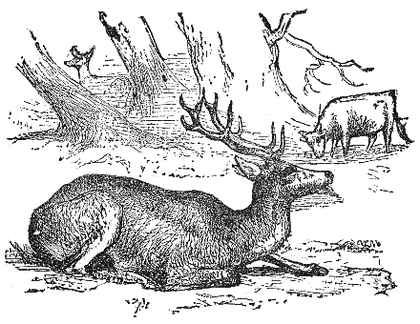
A sick Stag lay down in a quiet corner of his pasture-ground. His companions came in great numbers to inquire after his health, and each one helped himself to a share of the food which had been placed for his use; so that he died, not from his sickness, but from the failure of the means of living.
Evil companions bring more hurt than profit.
The Fowler and the Ringdove.
A Fowler took his gun, and went into the woods a shooting. He spied a Ringdove among the branches of an oak, and intended to kill it. He clapped the piece to his shoulder, and took his aim accordingly. But, just as he was going to pull the trigger, an adder, which he had trod upon under the grass, stung him so painfully in the leg that he was forced to quit his design, and threw his gun down in a passion. The poison immediately infected his blood, and his whole body began to mortify; which, when he perceived, he could not help owning it to be just. "Fate," said he, "has brought destruction upon me while I was contriving the death of another."
Men often fall into the trap which they prepare for others.
The Kid and the Wolf.
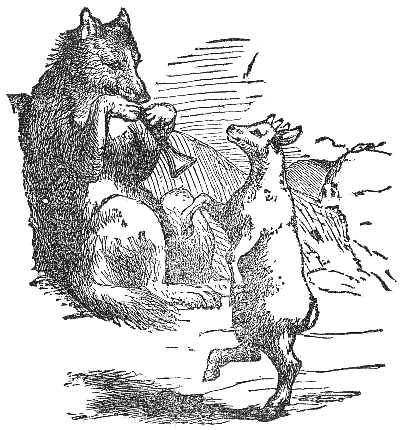
A Kid, returning without protection from the pasture, was pursued by a Wolf. He turned round, and said to the Wolf: "I know, friend Wolf, that I must be your prey; but before I die, I would ask of you one favor, that you will play me a tune, to which I may dance." The Wolf complied, and while he was piping, and the Kid was dancing, the hounds, hearing the sound, came up and gave chase to the Wolf. The Wolf, turning to the Kid, said: "It is just what I deserve; for I, who am only a butcher, should not have turned piper to please you."
Every one should keep his own colors.
The Blind Man and the Whelp.
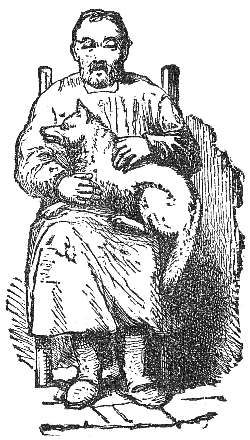
A Blind Man was accustomed to distinguish different animals by touching them with his hands. The whelp of a Wolf was brought him, with a request that he would feel it, and say what it was. He felt it, and being in doubt, said: "I do not quite know whether it is the cub of a Fox, or the whelp of a Wolf; but this I know full well, that it would not be safe to admit him to the sheepfold."
Evil tendencies are shown early in life.
The Geese and the Cranes.
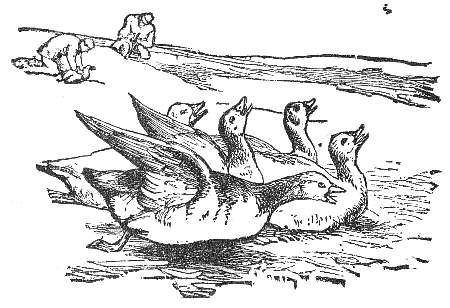
The Geese and the Cranes fed in the same meadow. A bird-catcher came to ensnare them in his nets. The Cranes, being light of wing, fled away at his approach; while the Geese, being slower of flight and heavier in their bodies, were captured.
Those who are caught are not always the most guilty.
The North Wind and the Sun.
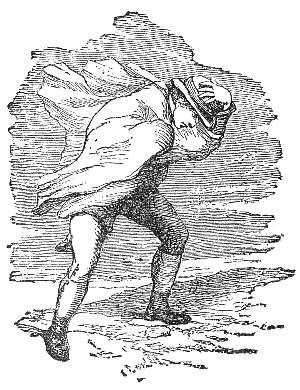
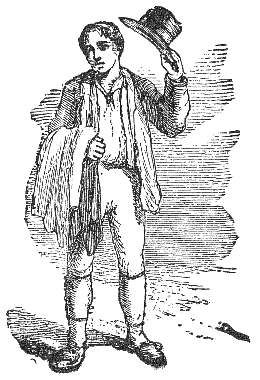
The North Wind and the Sun disputed which was the more powerful, and agreed that he should be declared the victor who could first strip a wayfaring man of his clothes. The North Wind first tried his power, and blew with all his might; but the keener became his blasts, the closer the Traveler wrapped his cloak around him, till at last, resigning all hope of victory, he called upon the Sun to see what he could do. The Sun suddenly shone out with all his warmth. The Traveler no sooner felt his genial rays than he took off one garment after another, and at last, fairly overcome with heat, undressed, and bathed in a stream that lay in his path.
Persuasion is better than Force.
The Laborer and the Snake.
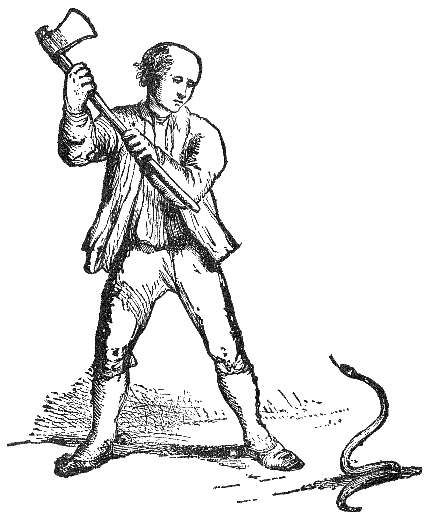
A Snake, having made his hole close to the porch of a cottage, inflicted a severe bite on the Cottager's infant son, of which he died, to the great grief of his parents. The father resolved to kill the Snake, and the next day, on its coming out of its hole for food, took up his axe; but, making too much haste to hit him as he wriggled away, missed his head, and cut off only the end of his tail. After some time, the Cottager, afraid lest the Snake should bite him also, endeavored to make peace, and placed some bread and salt in his hole. The Snake said: "There can henceforth be no peace between us; for whenever I see you I shall remember the loss of my tail, and whenever you see me you will be thinking of the death of your son."
It is hard to forget injuries in the presence of him who caused the injury.
The Bull and the Calf.
A Bull was striving with all his might to squeeze himself through a narrow passage which led to his stall. A young Calf came up and offered to go before and show him the way by which he could manage to pass. "Save yourself the trouble," said the Bull; "I knew that way long before you were born."
Do not presume to teach your elders.
The Goat and the Ass.
A Man once kept a Goat and an Ass. The Goat, envying the Ass on account of his greater abundance of food, said: "How shamefully you are treated; at one time grinding in the mill, and at another carrying heavy burdens;" and he further advised him that he should pretend to be epileptic, and fall into a deep ditch and so obtain rest. The Ass gave credence to his words, and, falling into a ditch, was very much bruised. His master, sending for a leech, asked his advice. He bade him pour upon the wounds the blood of a Goat. They at once killed the Goat, and so healed the Ass.
In injuring others we are apt to receive a greater injury.
The Boasting Traveler.
A Man who had traveled in foreign lands boasted very much, on returning to his own country, of the many wonderful and heroic things he had done in the different places he had visited. Among other things, he said that when he was at Rhodes he had leaped to such a distance that no man of his day could leap anywhere near him—and as to that there were in Rhodes many persons who saw him do it, and whom he could call as witnesses. One of the bystanders, interrupting him, said: "Now, my good man, if this be all true, there is no need of witnesses. Suppose this to be Rhodes and now for your leap."
Cure a boaster by putting his words to the test.