The Old Hound.
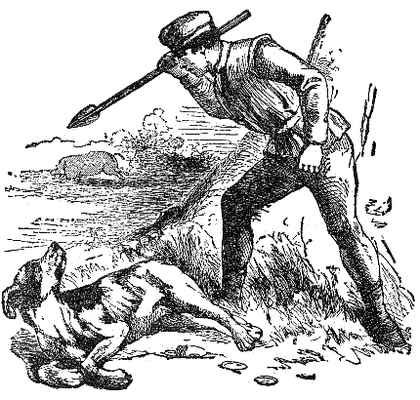
A Hound, who in the days of his youth and strength had never yielded to any beast of the forest, encountered in his old age a boar in the chase. He seized him boldly by the ear, but could not retain his hold because of the decay of his teeth, so that the boar escaped. His master, quickly coming up, was very much disappointed, and fiercely abused the dog. The Hound looked up and said: "It was not my fault, master; my spirit was as good as ever, but I could not help mine infirmities. I rather deserve to be praised for what I have been, than to be blamed for what I am."
No one should be blamed for his infirmities.
The Crow and the Pitcher.
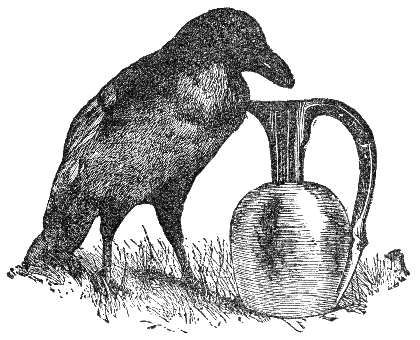
A Crow, perishing with thirst, saw a pitcher, and, hoping to find water, flew to it with great delight. When he reached it, he discovered to his grief that it contained so little water that he could not possibly get at it. He tried everything he could think of to reach the water, but all his efforts were in vain. At last he collected as many stones as he could carry, and dropped them one by one with his beak into the pitcher, until he brought the water within his reach, and thus saved his life.
Necessity is the mother of invention.
The Ass Eating Thistles.
An Ass was loaded with good provisions of several sorts, which, in time of harvest, he was carrying into the field for his master and the reapers to dine upon. By the way he met with a fine large Thistle, and, being very hungry, began to mumble it; and while he was doing so he entered into this reflection: "How many greedy epicures would think themselves happy, amidst such a variety of delicate viands as I now carry! But to me this bitter, prickly Thistle is more savory and relishing than the most exquisite and sumptuous banquet. Let others choose what they may for food, but give me, above everything, a fine juicy thistle like this and I will be content."
Every one to his taste: one man's meat is another man's poison, and one man's poison is another man's meat; what is rejected by one person may be valued very highly by another.
The Wolf and the Lion.
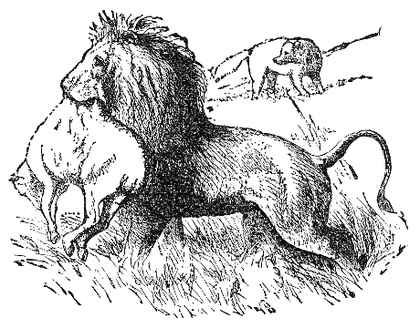
A Wolf, having stolen a lamb from a fold, was carrying him off to his lair. A Lion met him in the path, and, seizing the lamb, took it from him. The Wolf, standing at a safe distance, exclaimed: "You have unrighteously taken from me that which was mine." The Lion jeeringly replied: "It was righteously yours, eh? Was it the gift of a friend, or did you get it by purchase? If you did not get it in one way or the other, how then did you come by it?"
One thief is no better than another.
The King's Son and the Painted Lion.
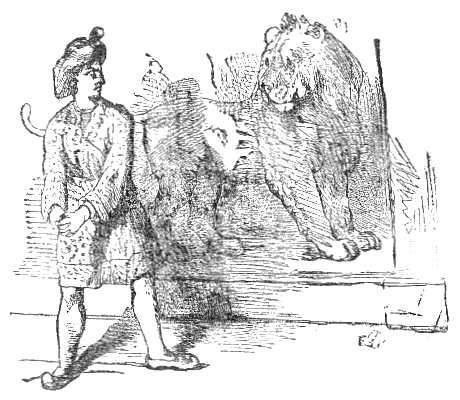
A King who had one only son, fond of martial exercises, had a dream in which he was warned that his son would be killed by a lion. Afraid lest the dream should prove true, he built for his son a pleasant palace, and adorned its walls for his amusement with all kinds of animals of the size of life, among which was the picture of a lion. When the young Prince saw this, his grief at being thus confined burst out afresh, and standing near the lion, he thus spoke: "O you most detestable of animals! through a lying dream of my father's, which he saw in his sleep, I am shut up on your account in this palace as if I had been a girl. What shall I now do to you?" With these words he stretched out his hands toward a thorn-tree, meaning to cut a stick from its branches that he might beat the lion, when one of its sharp prickles pierced his finger, and caused great pain and inflammation, so that the young Prince fell down in a fainting fit. A violent fever suddenly set in, from which he died not many days after.
We had better bear our troubles bravely than try to escape them.
The Trees and the Axe.
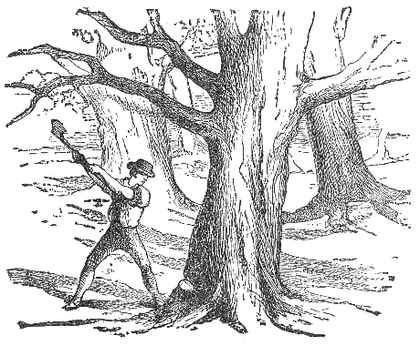
A Man came into a forest, and made a petition to the Trees to provide him a handle for his axe. The Trees consented to his request, and gave him a young ash-tree. No sooner had the man fitted from it a new handle to his axe, than he began to use it, and quickly felled with his strokes the noblest giants of the forest. An old oak, lamenting when too late the destruction of his companions, said to a neighboring cedar: "The first step has lost us all. If we had not given up the rights of the ash, we might yet have retained our own privileges and have stood for ages."
In yielding the rights of others, we may endanger our own.
The Seaside Travelers.
Some travelers, journeying along the sea-shore, climbed to the summit of a tall cliff, and from thence looking over the sea, saw in the distance what they thought was a large ship, and waited in the hope of seeing it enter the harbor. But as the object on which they looked was driven by the wind nearer to the shore, they found that it could at the most be a small boat, and not a ship. When, however, it reached the beach, they discovered that it was only a large fagot of sticks, and one of them said to his companions: "We have waited for no purpose, for after all there is nothing to see but a fagot."
Our mere anticipations of life outrun its realities.
The Sea-gull and the Kite.
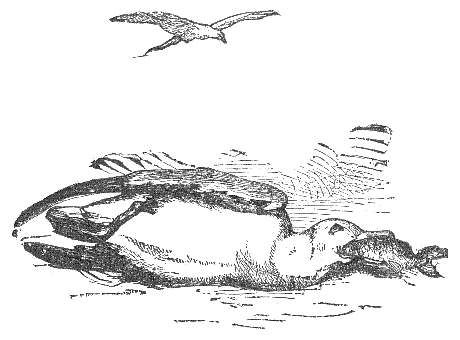
A Sea-gull, who was more at home swimming on the sea than walking on the land, was in the habit of catching live fish for its food. One day, having bolted down too large a fish, it burst its deep gullet-bag, and lay down on the shore to die. A Kite, seeing him, and thinking him a land bird like itself, exclaimed: "You richly deserve your fate; for a bird of the air has no business to seek its food from the sea."
Every man should be content to mind his own business.
The Monkey and the Camel.
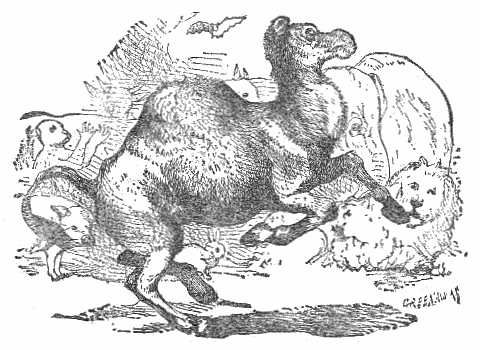
The beasts of the forest gave a splendid entertainment, at which the Monkey stood up and danced. Having vastly delighted the assembly, he sat down amidst universal applause. The Camel, envious of the praises bestowed on the Monkey, and desirous to divert to himself the favor of the guests, proposed to stand up in his turn, and dance for their amusement. He moved about in so very ridiculous a manner, that the Beasts, in a fit of indignation, set upon him with clubs, and drove him out of the assembly.
It is absurd to ape our betters.
The Rat and the Elephant.
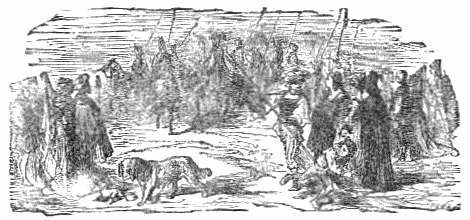
A Rat, traveling on the highway, met a huge elephant, bearing his royal master and his suite, and also his favorite cat and dog, and parrot and monkey. The great beast and his attendants were followed by an admiring crowd, taking up all of the road. "What fools you are," said the Rat to the people, "to make such a hubbub over an elephant. Is it his great bulk that you so much admire? It can only frighten little boys and girls, and I can do that as well. I am a beast; as well as he, and have as many legs and ears and eyes. He has no right to take up all the highway, which belongs as much to me as to him." At this moment, the cat spied the rat, and, jumping to the ground, soon convinced him that he was not an elephant.
Because we are like the great in one respect we must not think we are like them in all.